www.hypersmash.com

تابعنا على شبكاتنا الإجتماعية

This is default featured post 1 title

Go to Blogger edit html and find these sentences.Now replace these sentences with your own descriptions.This theme is Bloggerized by Lasantha Bandara - Premiumbloggertemplates.com.

This is default featured post 2 title

Go to Blogger edit html and find these sentences.Now replace these sentences with your own descriptions.This theme is Bloggerized by Lasantha Bandara - Premiumbloggertemplates.com.

This is default featured post 3 title

Go to Blogger edit html and find these sentences.Now replace these sentences with your own descriptions.This theme is Bloggerized by Lasantha Bandara - Premiumbloggertemplates.com.

This is default featured post 4 title

Go to Blogger edit html and find these sentences.Now replace these sentences with your own descriptions.This theme is Bloggerized by Lasantha Bandara - Premiumbloggertemplates.com.

This is default featured post 5 title

Go to Blogger edit html and find these sentences.Now replace these sentences with your own descriptions.This theme is Bloggerized by Lasantha Bandara - Premiumbloggertemplates.com.

Showing posts with label Death Be Not Proud. Show all posts

Friday, April 26, 2013

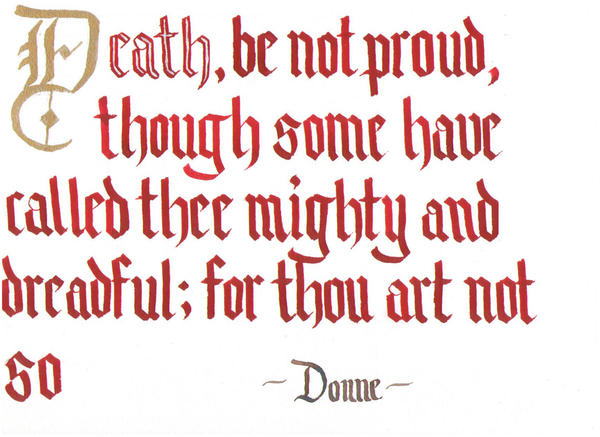
Holy Sonnet 10, "Death be not proud"


Holy Sonnet 10, "Death be not proud"

   By John Donne

  The poet depict death as a force that is supposed to be (mighty ,dreadful) because it kills everybody but he denies it's invincibility ,pity poor death and declaring that it will not kill him ,assuming the voice of a preacher. John Donne was an Anglican minister , we see that the poet attempts to convince his audience by the power of his rhetorical attack ,and his faith in the afterlife not to be afraid of death saying that people actually do not die forever                                                                    
In a series of paradoxes the poet attacks the conventional characterization of death as mans invincible conqueror rather than being a fearful experience, death brings greater release and pleasure than rest and sleep which people use to restore their energy ,death not  only provides rest of bones but also souls delivery ,a release in to a peaceful eternity.. Moreover death is not a tyrant that it imagines itself to be rather it is a slave to arbitrary dictates of fate and chance ,to the whims of capricious monarchs and murderers.                                                
 Death is associated only with the most destructive elements in life ,poison, war, and sickness moreover, drugs can put a person to sleep as easily as than death does ,thus as a result it's servility, weakness, and association with the worst human events ,death should not swell with pride. The final two lines, an un-rhyming  couplet, some up the poet’s defeat of vainglorious death: people may die, but they do not stay dead. They awaken from death as if from a short sleep in to an eternity in which death shall be no more. Death shall die then, but humans will live eternally.                                                                                       
The principle poetic technique used by Donne to diminish death are to depict it as a person and then challenge death as if the poet is engaged in a single combat with it.                               
Death can come in so many ways at any time to anybody that is seems to have myriad forms so Donne produce death by presenting it as a weak person ,subservient to the worst elements of life and unable to counter the poet challenge.          
One of the central irony of the poem is demonstrated by Donne's use of variants of death and words related to it to dominate a poem directed against death is the first word of the sonnet and the last line which declares the end of death contain "Death" twice and "Die" as the last word of the couplet. 
Death be not proud is a sonnet concern the ways in which one can defeat the fear of death and anticipates the happiness of an eternal afterlife ,the poet create various derogatory ,images of death in an effort to reduce it power as human kind most ubiquitous enemy .                                                                            


Wednesday, April 24, 2013

الفصل الثالث محاكمة هيستر برين


الفصل الثالث

كان فى هندي من الهنود الحمر و كان شكله غريب بس مش لدرجة انهم راح يسبو هستر ويطالعو فيه وكان جمبه رجل ابيض لابس لبس همجي على متحضر و جسمه صغير و كان واضح على وجهه علامات الذكاء و التقدم فى السن وكان واحد من كتوفه اعلى من الثاني. لما هستر شافت هذا الرجل حضنت الطفل لدرجة صار يبكى وما انتبهت لبكائه. وهو طالع لها بنظره عفوية بعدين نظر لها بتمعن و وجهه اسود بس بعدين اتحكم بردة فعله و لما شافها انتبتهت له حط اصباعه على فمه بإشارة لها انها تسكت ولمس كتف واحد واقف جمبه وسئله مين هذي؟ واش حكايتها! الرجل قاله شكلك غريب عن هنا هذى هستر براين الى عملت الفضيحة فى الكنيسة قالة ايوة أنا غريب كنت فى البحر وضعت وهذا الهندي هو الى انقذ حياتى ورجع سئله عن حكياة هستر راح الرجال قاله ان هذى المرأة زوجها واحد انجليزي و ارسلها قبله الى بوسطن و بعدين طلعت الفضيحة وقاله ان البنت الى شايلتها ماهى من زوجها وهى رافضة تعترف مين ابو البنت وقال المفروض ان زوجها يجي عشان يشوف الى صار وهذول الى فى الكنيسة قالو انه فى احد ضحك عليها عشان كذا ماعاقبوها العقاب القاسي واكتفو بأنها توقف عالمنصة دى كل يوم تلات ساعات وتشيل الحرف على صدرها العمر كله.هذى العقوبة حكيمة انها تشيل العار طول عمرها حتى لما تموت راح ينحط الحرف على قبرها لكن يؤسفنى ان شريكها فى الجريمة مارح يوقف معاها لكنه راح ينعرف راح ينعرف راح ينعرف. الرجل شكره ومشي وهستر كانت تطالع له وكئنه مابقى في المكان غيرها وغيره وكانت خايفه من مقابلة الشخص دا.فى احد كان ينادى هستر بس هى ما انتبهت الا لما ناداها مره ثانيه.طالعت هستر فى الى كان يناديها وكان جون وينلسون هو الى ينادي عليها وهو من كبار بوسطن وقالها ان هذا الشخص –اشار لرجل يقف لجواره الى اسمه المنستر ديمزديل- اقنعنى انى مايصير اخليكي تفضحى أسرار قلبك قدام الناس وهذا الرجل طلب انه يكون هو الى يتكلم معاكي ويعرف منك شريكك في هذه الجريمة . المنستر ديمزديل سئها عن شريكها و طلب منها تعترف لكنها قالت انها راح تشيل عارها وعارها حاول يقنعها تعترف لكن هى رفضت وخلص عقابها ورجعت للسجن تانى.

Tuesday, April 23, 2013

Fleur Adcock Immigrant Summary Analyzing


Fleur Adcocks Immigrant
Summary: The poem "Immigrant" was written by the author Fleur Adcock, focusing on her personal experience when migrating from New Zealand to London, England sometimes during the 60s. The poem talks about her 8th month in London on a bridge looking at the pelicans down on the surface of the river. She watched them while describing their awkward motion of ducking their beaks under the water. Adcock then reveals the fact that she is still trying to practice of avoiding her New Zealand accent.
Analyzing: The poems literally talks about her personal experience with Saint James Park's scenery when visiting the place. Adcock used the metaphor "pelicans" with respect to immigrants because pelicans are the "immigrant" birds on the lake trying to cope with the environment and surrounding. This portrays the assimilation process as the author and the pelicans both trying to adapt to the new environment. One person trying to fix her pronunciation while the animals trying to cope with natural environment. The tone of the poem is calm, follows by a description of the activities of the pelicans, which stimulated the reader a sense of 
peace, yet awkward. The poem reflects the processes of immigration and assimilation.


Fleur Adcock (b.1934) is a New Zealander by birth but spent part of her childhood in England, returning to live in London in 1963. She worked as a librarian until 1979 before becoming a freelance writer. She is the author of ten books of poetry and a collected edition of her work, Poems 1960-2000, was published by Bloodaxe in 2000. Recipient of a Cholmondeley Award in 1976 and a New Zealand National Book Award in 1984, she was awarded an OBE in 1996.

The influence of Fleur Adcock's migratory childhood can be traced in her work's exploration of identity. In her poem 'Immigrant' this is specifically an issue of voice as she practices her newly adopted English accent. Several of the poems here examine roots and rootlessness: as she puts it in 'Chippenham', a poem recalling her status as the odd one out in an English classroom, "Who did I think/I was . . .?" Identity is also an issue of gender: in 'The Russian War' a returning uncle claims he'll "be a thing called oral history" but Adcock is acutely aware of those female ancestors whose stories have disappeared, like the silent labouring woman in 'Water'. Her poems often bring to light women's lives that might otherwise be marginalised or forgotten, as in the poignant vignettes of suffering in 'The Soho Hospital for Women'. However, her poems have no air of stridency: her characteristic tone is restrained, rational, conversational. Adcock herself has talked about this poetic strategy: "The tone I feel at home in is one in which I can address people without embarrassing them; I should like them to relax and listen as if to an intimate conversation". ('Not Quite a Statement', Strong Words, Bloodaxe Books, 2000).

Certainly this quality of intimacy is to the fore in her Archive recording. Her reading voice is clear and distinct, striking the consonants with precision and just the faintest hint of her original accent. A particular pleasure are her generous explanations of the poems and the insights she gives into her creative process: apparently "the bath is a very good place for getting inspiration."

Her recording was made on 13 June 2001 at The Audio Workshop, London and was produced by Richard Carrington.

Emily Dickinson A Bird came down the Walk summary analysis


Emily Dickinson s A Bird came down the Walk
ban_dickinson.gif (620×100)

Summary

The speaker describes once seeing a bird come down the walk, unaware that it was being watched. The bird ate an angleworm, then “drank a Dew / From a convenient Grass—,” then hopped sideways to let a beetle pass by. The bird’s frightened, bead-like eyes glanced all around. Cautiously, the speaker offered him “a Crumb,” but the bird “unrolled his feathers” and flew away—as though rowing in the water, but with a grace gentler than that with which “Oars divide the ocean” or butterflies leap “off Banks of Noon”; the bird appeared to swim without splashing.

Form

Structurally, this poem is absolutely typical of Dickinson, using iambic trimeter with occasional four-syllable lines, following a loose ABCB rhyme scheme, and rhythmically breaking up the meter with long dashes. (In this poem, the dashes serve a relatively limited function, occurring only at the end of lines, and simply indicating slightly longer pauses at line breaks.)

images (252×200)

Commentary

Emily Dickinson’s life proves that it is not necessary to travel widely or lead a life full of Romantic grandeur and extreme drama in order to write great poetry; alone in her house at Amherst, Dickinson pondered her experience as fully, and felt it as acutely, as any poet who has ever lived. In this poem, the simple experience of watching a bird hop down a path allows her to exhibit her extraordinary poetic powers of observation and description.
Dickinson keenly depicts the bird as it eats a worm, pecks at the grass, hops by a beetle, and glances around fearfully. As a natural creature frightened by the speaker into flying away, the bird becomes an emblem for the quick, lively, ungraspable wild essence that distances nature from the human beings who desire to appropriate or tame it. But the most remarkable feature of this poem is the imagery of its final stanza, in which Dickinson provides one of the most breath-taking descriptions of flying in all of poetry. Simply by offering two quick comparisons of flight and by using aquatic motion (rowing and swimming), she evokes the delicacy and fluidity of moving through air. The image of butterflies leaping “off Banks of Noon,” splashlessly swimming though the sky, is one of the most memorable in all Dickinson’s writing.

In the Garden
A bird came down the walk:
He did not know I saw;
He bit an angle-worm in halves
And ate the fellow, raw.
And then he drank a dew
From a convenient grass,
And then hopped sidewise to the wall
To let a beetle pass.
He glanced with rapid eyes
That hurried all abroad,--
They looked like frightened beads, I thought;
He stirred his velvet head
Like one in danger; cautious,
I offered him a crumb,
And he unrolled his feathers
And rowed him softer home
Than oars divide the ocean,
Too silver for a seam,
Or butterflies, off banks of noon,
Leap, plashless, as they swim.
The speaker observes the bird and tries to establish contact with the bird by offering it food. The bird flies off. A few of the speaker's details describe the bird as a wild creature in nature, and more details present his behavior and his appearance in terms of human behavior.
Stanza one
Because the bird does not know the speaker is present, he behaves naturally, that is, his behavior is not affected by her presence. We see the bird's "wildness" or non-humanness in his biting the worm in half and eating it. "Raw" continues to emphasize his wildness. Ironically the word "raw" carries an implication of civilized values and practices ("raw" implicitly contrasts with cooked food). Why mention that the bird ate the worm raw? Would you expect the bird to cook the worm? In contrast, the fact that the bird "came" down the walk sounds civilized, socialized.  Does this description sound like someone walking on a sidewalk?
Stanza two
The birds' drinking dew (note the alliteration) suggests a certain refinement, and "from a grass" makes the action resemble the human action of drinking from a glass. And the bird politely allows a beetle to pass.
Stanza three
In lines one and two, the description of the bird's looking around is factual description and suggests the bird's caution and fear, as well as a possible threat in nature. With lines three and four, the speaker describes the bird in terms of civilization, with "beads" and "velvet."
Stanza four
The idea of danger in nature is made explicit but remains a minor note in this stanza and in the poem. It occupies only half a line, "Like one in danger." "Cautious," the speaker offers the crumb. How is "cautious " meant? Does the speaker feel the need to be cautious? or does she offer the crumb cautiously? (One of the characteristics of Dickinson's poetry is a tendency to drop endings as well as connecting words and phrases; you have to decide whether she has dropped the -ly ending from "cautious.")
Her action causes the bird to fly off. Her description of his flight details his beauty and the grace of his flight, a description which takes six lines. Does the idea of danger or of the bird's beauty receive more emphasis, or are the danger and the beauty emphasized equally? Does it matter in this poem whether one receives more emphasis than the other, that is, would the different emphases affect the meaning of the poem?
I am suggesting that this poem reveals both the danger and the beauty of nature. Does the poem support this reading? What might Dickinson's purpose be in having the narrator see the bird in "civilized" terms? Is it a way of pushing away or of controlling the threat and terrors that are always present and may suddenly appear in nature?

Monday, April 22, 2013

English Literature الأدب الإنجليزي


الأدب الإنجليزي
english_literature.jpg (400×300)
للأدب الإنكليزي English Literature مصدران رئيسيان الأول هو الحضارة اليونانية الرومانية، والثاني هو الكتاب المقدس. وربما كان من الضروري وضع هذين المصدرين في الذهن عند دراسة الأدب الإنكليزي في أي مرحلة من مراحله.
ومن المعروف أن أزهى عصور الحضارة الرومانية، الذي يمتد من القرن الأول قبل الميلاد حتى القرن الأول بعد الميلاد، كان انعكاساً لمنجزات الحضارة اليونانية. لذا كانت الحضارة الرومانية جسراً بين الحضارة الغربية ومنها الإنكليزية والحضارة اليونانية التي سادت من القرن الخامس إلى القرن الثالث قبل الميلاد. وقد ورث 

images (389×129)

الأدب الإنكليزي من حضارتي اليونان والرومان عالماً زاخراً من الأساطير والأحداث والصور التي مازالت تغنيه حتى الوقت الحاضر. وظلت الدراسات اليونانية واللاتينية إلى عهد قريب موضع اهتمام الصفوة من رجال العلم في جامعتي أكسفورد وكمبردج بوجه خاص، والجامعات الأوربية بوجه عام. وكم من أديب إنكليزي بدأ حياته الأدبية بدراسة التراث الاتباعي (الكلاسيكي) قبل أن تتفتح موهبته الفنيّة في الأدب المحلي. ومن هنا نشأت الحاجة إلى الرجوع إلى المصادر الاتباعية من أجل تذوق العمل الأدبي. وتكفي، مثالاً من بين عشرات الأمثلة، رواية «أوليس» Ulysses لجيمس جويس[ر]James Joyce وقصيدة «الأرض اليباب» The Waste Land للشاعر ت.س.إليوت[ر] T.S.Eliot.
وقد استفاد الأدب الإنكليزي من المصدر الآخر، وهو الكتاب المقدس،الذي ألهم الكتّاب بما يضمه من قصص ورموز دينية. ومن المعروف أن الترجمة الإنكليزية للكتاب المقدس التي صدرت عام 1611 برعاية ملك إنكلترة جيمس الأول قد تركت أثراً بيّناً في الأدب الإنكليزي. ومع وجود ترجمات أقدم من تلك فإن الكتّاب الإنكليز تأثروا بترجمة سنة 1611 التي أسهمت كثيراً في تكوين اللغة الأدبية عند الأجيال اللاحقة. ومن أهم ما استمدوه من هذا المصدر الديني ما عُقد على صلة الفرد بربه وبأفراد مجتمعه، تلك العلاقة التي تحدد مكانة الإنسان في هذا العالم، والتي تقضي بأن الفرد إنسان ناقص يحاول جاهداً الوصول إلى الكمال؛ والتقرب من ربه من أجل أن يحقق الخلاص بعد أن كتب عليه أن يعيش بذنب السقوط في هذه الدنيا. وقد استبدت هذه الفكرة بعقول المفكرين والأدباء الأوربيين قاطبة.
ويجدر بالذكر هنا أن هذه النظرة إلى الإنسان تناقض نظرة اليونان والرومان إليه، تلك النظرة التي ترى الإنسان مركز هذا الكون وصانع أقداره مع ما يحيط به من قوى خارقة. ويمكن توضيح هذه النظرة من مسرحية شلي[ر] ,,,,ley «بروميثيوس طليقاً» Prometheus Unbound التي استقاها كما يدل العنوان من الأدب اليوناني. وهكذا فإن صورة الفرد في الأدب الإنكليزي تترجح بين إنسان يشعر بعدم الكمال يسعى للوصول إلى وضع أكمل ليحرر نفسه من هذا الشعور، وإنسان يمتلك قوة خارقة ويبحث عن عالم يكتشفه ويمتلكه بهذه القوة التي يشار إليها في أغلب الأحيان بالخيال. 

تابع قراءة الموضوع هنا

خصائص برج الحمل حصري

برج الحمل (21 مارس - 19 ابريل)
اول برج في الزودياك ويرمز الى الولادة والطفولة وهكذا انسان برج الحمل يدور في فلكه مهتما بحاجاته اذا سعىالى شيء قام بالمستحيل للوصول اليه هل هي الانانية! نعم اذا اعتبرنا الاطفال انانيين انه بريء براءةالطفل الامر الذي يشفع لتلك العدائية التي عرفت عنه .

هذا البرج يعتبر من الأبراج الذكورية، وهو نهاري ناري،يحب عمل المعروف مع كل الناس، يتميز بالمرح الشديد وسرعة البديهة، مواليده يكرهون التفكير في المشكلات المادية ويرفضون استبقاءها ويشعرون بروح المغامرة، فهم يملكون حركة وحيوية لا حدود لها. طبيعة هذا البرج نارية، وكوكبه المريخ.

جرأة انسان الحمل تدعو الىالحيرة والاستغراب فبينما نراه يشق طريقه بعزم وثبات نجده يرتعش وينكمش امام الاوجاع الجسدية .
يغلب على مواقفه التحرر والفرديه يجود بوقته وماله وان كان يفتقر الى الرقة واللباقة وهو قليل الصبر.

اما في ميدان الصداقة فهو محب وكريم من شيمه المواظبة والاقدام مثل القائد الباسل .
يجهل الكذب والتحايل ويتبع الاسلوب المباشر في جميع تحركاته.

الرجل في برج الحمل :
حيوية الأحلام مواليد الحمل في شهر آذار (مارس) نساء ورجالا يتصفون بروحانية عالية، وهم اقل حركة وعنفوانا واقل تصلبا وعصبية من المواليد في شهر نيسان/ إبريل، بسبب مغناطيسية القمر وذبذباته التي تؤثر مباشرة في مجمل تصرفاتهم ولديهم طبيعة متناقضة هي اقرب إلى مواليد الحوت في شهر آذار (مارس).

مولود الحمل قلب في عقل وعقل في قلب قد يكون أنانيا ولكن نادرا ما نصادف حملا بخيلا فبقدر اهتمامه بالمظاهر وبحبه لحياة البذخ والترف وكل وسيلة تساعده على الظهور فقد لا يهتم كثيرا للثراء في مقابل اهتمامه للمراكز العالية ولدور قيادي وتوفير حياة صاخبة ومثيرة، تجذبه الأضواء والشهرة وكل ما يدفعه إلى الصفوف الأمامية. كريم ومضياف يحترم العائلة وروابطها وهو خير من يعقد مصالحات اجتماعية، ويعشق الأطفال ولوالدته مكانه خاصة في قلبه. هذا الرجل الذي يبدو للوهلة الأولى جادا ورصينا وربما وقحا، في داخله مشاعر عميقة وروح إنسانية كبيرة.. فهو يقدم لزوجته أو حبيبته كل ما تحتاج إليه، ويرغب في أن يراها أجمل النساء، ولكنه يفضل ألا تسأله عن أموره المالية.

انه حنون عاطفي وجريء يقتحم المخاطر بشجاعة وهو من الشخصيات التي تقاتل بعنف ويقبل التحدي بسهولة مهما كانت النتائج، وهو عادة لا يتوقع الهزيمة.. معه لن تشعر المرأة بالملل، فالروتين يقتل حماسه، وهو بحاجة دائما إلى الإثارة، على المرأة أن تكون جاهزة في كل وقت لمفاجأته، وأن تحترم حاجته الكبرى إلى الاستقلالية، وإلا سيتحول إلى شخص عدواني وانتقاداته لاذعة، وفي ساعة غضبه يوجه كلاما جارحا ومؤذيا قد يدمر علاقته بحبيبته، إلا أنها قد تأخذ منه الكثير والمستحيل أن تعاملت معه بلطف وحنان وذكاء.

الأبراج التي تلائم برج الحمل:- إن البرجين اللذين يمكن أن يقيم برج الحمل علاقة ناجحة معهما البرجان الناريان الأسد والقوس.


المرأة في برج الحمل :
طبيعتها المستقلة الانفرادية تتيح لها الاتكال على نفسها في مختلف الاعمال والواجبات اليومية .
من افضل صفاتها الصدق والتفاؤل والاخلاص ويرضيها من الرجل اعتدال العاطفة.

وهي مع ذلك انفعالية تفقد سيطرتها على نفسها وتستعيد هدوءها بسرعة مماثلة ابتسامتها دائما مشرقة وتفاؤلها مستمر وان كانت سريعة العطب. بسبب صدقها وطيبها اذا ساعدها الحظ ولقيت الرجل الملاءم تحولت الى نعجة طيبة مسالمة وبات زوجها من اسعد الرجال.

تنجذب المرأة الحمل انجذابا قويا ناحية الأسد، كما يمكن أن تقيم معه علاقة مرحة مسلية لانهما يملكان صفات وهوايات مشتركة تساعدها على أن تكون صديقة وحبيبة في الوقت نفسه... يستطيع الأسد أن يعطيها طاقته المندفعة والاستقرار والنظام اللذين تحتاج اليهما...مع القوس تستطيع أن تبني علاقة مثيرة وفورية ... تسافر معه إلى أماكن بعيدة وتشعر بان حياتها مغامرة رائعة معه، يمكنها أن تبني معه جسرا من التفاهم الشديد.

مشاهير ينتمون لهذا البرج : 
عمر الشريف ، تشارلي تشابلن، أدولف هتلر، بات ديفز، مارلون براندو، توماس جيفرسون، ديفيد جينسن، دوريس داي، جلوريا سوانسون، ديانا روس، تينيس ويليامز، التون جون، أنتوني بيركنز، فنسنت فان جوخ، إيدي ميرفي .


"Analysis on John Donne’s "Death Be Not Proud 1572-1631


"Analysis on John Donne’s "Death Be Not Proud


Death Be Not Proud

by John Donne

(1572-1631)

DEATH be not proud, though some have called thee

Mighty and dreadfull, for, thou art not so,
For, those, whom thou think’st, thou dost overthrow,
Die not, poore death, nor yet canst thou kill me.
From rest and sleepe, which but thy pictures bee,
Much pleasure, then from thee, much more must flow,
And soonest our best men with thee doe goe,
Rest of their bones, and soules deliverie.
Thou art slave to Fate, Chance, kings, and desperate men,
And dost with poyson, warre, and sicknesse dwell,
And poppie, or charmes can make us sleepe as well,
And better then thy stroake; why swell’st thou then;
One short sleepe past, wee wake eternally,
And death shall be no more; death, thou shalt die. 


Derick Ariyam
November 21, 2005


A Critical Analysis of “Death Be Not Proud” by John Donne


The sonnet “Death Be Not Proud”, written by John Donne around the year 1618, is one of many sonnets that are part of a collection called The Holy Sonnets. This collection is comprised of nineteen sonnets with themes that pertain to Christian philosophy. 


“Death Be Not Proud” is a powerful declaration against death, in which death is personified as a tyrant without real power “…some have called thee / Mighty and dreadfull, for, thou art not soe” (1-2). The poem continues to dismantle death from something mysterious and feared, to something weak and irrelevant. The speaker’s main polemic is grounded in the beliefs of Christian philosophy, in particular, its promise of eternal life. But prior to this, the poem dismantles death from secular angles as well.


From a structural standpoint, the poem tightly adheres to the sonnet form, which is defined as a lyric poem that adheres to a conventional rhyme scheme and is usually made up of fourteen lines (Murfin, Ray 450). The rhyme scheme for this poem is “abbaabbacddcee”. 


The poem attacks death from two different angles: a secular angle and a religious angle. The first twelve lines are mostly secular in the sense that a non-Christian can at least follow the argument. The last two lines require a belief in Christianity, and with this belief, comes the more powerful, irrefutable claim, dramatically stated in the words “And death shall be no more; Death, thou shalt die”(14), which pertains to the Christian concept of Eternal Life. 


The first angle, the secular, the speaker starts with a feeling of disdain and loathing in the words used against death, creating an immediate pejorative connotation with this character. This is followed by flippancy and mocking: “Die not, poore Death, nor yet canst thou kill me” (4). Here the words “poore Death” are used to diminish Death’s formidability. 


This line follows with another that has the same enervating effect, “From rest and sleep, which but thy pictures be, / Much pleasure; then from thee much more most flow” (5-6). Here the speaker, using logic, is stating that since death appears outwardly to be merely a sleep, and sleep being a pleasurable thing, death must be even more pleasurable. 


Flippancy and mocking is then turned into disarmament as the speaker addresses Death as a slave, at the whim of external influences, “Thou art slave to Fate, Chance, kings, and desperate men” (9). This line intimates that death has no real power, but is merely summoned like an instrument without complete autonomy of its own will.


The last part of the poem, particularly in the last two lines, forms the more powerful and convincing argument against the fortitude of death; however, it requires a belief in Christianity.


According to Christian philosophy, those that believe in Christ will never die but live eternally, "That whosoever believeth in him should not perish, but have eternal life" (John. 3.15 King James Version). This is not to imply that believers escape the natural course of all living things, which is to eventually cease from living, to die; death to Christians is not a ceasing of life, but rather, an entering into life, a better life, an eternal life. In essence, the earthly perishable body is left behind and the soul continues to live forever thereby escaping death: 


"So when this corruptible shall have put on incorruption, and this mortal shall have put on immortality, then shall be brought to pass the saying that is written, Death is swallowed up in victory" (1 Cor. 15.54).


In the aforementioned passage from the King James Version of the Bible, Saint Paul, in his letter to the Corinthians, again reiterates the Christian faith’s view of death as something “irrelevant”, a similar view that is taken in John Donne’s sonnet “Death Be Not Proud”.


The last line of the poem is the final thrust against death. It is a claim that death is meaningless, and a paradox. This is written as a recursive statement “…death, thou shalt die”(14). Since there is no death, the only thing left is Eternal Life. 


But this poem is not merely a remonstration; it is also a passionate piece of writing that is imbued with emotion and sounds. Starting from the first line, “Death be not proud, though some have called thee / Mighty and dreadful, for thou art not so” (1-2), the words that are chosen and their placement, adds a peremptory tone to this first declaration; these are lines that can not be whispered, but rather, belched out sonorously. 


The entire poem follows in this manner, as a declaration loudly commanded. This continues up until the last lines of the sonnet, where the tone shifts to that of “finality”, “And death shall be no more; Death, thou shalt die” (14). Also, many of the words in this poem bear heavy connotations, “Thou are slave to Fate, Chance, kings, and desperate men” (9), the words “slave” and “desperate” are words with strong emotional connotations. 


“Death Be Not Proud” by John Donne, is a sonnet from the revered Holy Sonnets that passionately argues against the formidability of death. The poem cites the Christian hope of Eternal Life as the ultimate escape from death, but does provide secular arguments as well that work in lightening the concept of death. But beyond this, the sonnet is a literary work of 
immense beauty and structure; it is a brilliant work from any point-of-view.

Twitter Delicious Facebook Digg Stumbleupon Favorites More

 
www.hypersmash.com