www.hypersmash.com

تابعنا على شبكاتنا الإجتماعية

This is default featured post 1 title

Go to Blogger edit html and find these sentences.Now replace these sentences with your own descriptions.This theme is Bloggerized by Lasantha Bandara - Premiumbloggertemplates.com.

This is default featured post 2 title

Go to Blogger edit html and find these sentences.Now replace these sentences with your own descriptions.This theme is Bloggerized by Lasantha Bandara - Premiumbloggertemplates.com.

This is default featured post 3 title

Go to Blogger edit html and find these sentences.Now replace these sentences with your own descriptions.This theme is Bloggerized by Lasantha Bandara - Premiumbloggertemplates.com.

This is default featured post 4 title

Go to Blogger edit html and find these sentences.Now replace these sentences with your own descriptions.This theme is Bloggerized by Lasantha Bandara - Premiumbloggertemplates.com.

This is default featured post 5 title

Go to Blogger edit html and find these sentences.Now replace these sentences with your own descriptions.This theme is Bloggerized by Lasantha Bandara - Premiumbloggertemplates.com.

Showing posts with label poems. Show all posts

Wednesday, April 24, 2013

الفصل الثالث محاكمة هيستر برين


الفصل الثالث

كان فى هندي من الهنود الحمر و كان شكله غريب بس مش لدرجة انهم راح يسبو هستر ويطالعو فيه وكان جمبه رجل ابيض لابس لبس همجي على متحضر و جسمه صغير و كان واضح على وجهه علامات الذكاء و التقدم فى السن وكان واحد من كتوفه اعلى من الثاني. لما هستر شافت هذا الرجل حضنت الطفل لدرجة صار يبكى وما انتبهت لبكائه. وهو طالع لها بنظره عفوية بعدين نظر لها بتمعن و وجهه اسود بس بعدين اتحكم بردة فعله و لما شافها انتبتهت له حط اصباعه على فمه بإشارة لها انها تسكت ولمس كتف واحد واقف جمبه وسئله مين هذي؟ واش حكايتها! الرجل قاله شكلك غريب عن هنا هذى هستر براين الى عملت الفضيحة فى الكنيسة قالة ايوة أنا غريب كنت فى البحر وضعت وهذا الهندي هو الى انقذ حياتى ورجع سئله عن حكياة هستر راح الرجال قاله ان هذى المرأة زوجها واحد انجليزي و ارسلها قبله الى بوسطن و بعدين طلعت الفضيحة وقاله ان البنت الى شايلتها ماهى من زوجها وهى رافضة تعترف مين ابو البنت وقال المفروض ان زوجها يجي عشان يشوف الى صار وهذول الى فى الكنيسة قالو انه فى احد ضحك عليها عشان كذا ماعاقبوها العقاب القاسي واكتفو بأنها توقف عالمنصة دى كل يوم تلات ساعات وتشيل الحرف على صدرها العمر كله.هذى العقوبة حكيمة انها تشيل العار طول عمرها حتى لما تموت راح ينحط الحرف على قبرها لكن يؤسفنى ان شريكها فى الجريمة مارح يوقف معاها لكنه راح ينعرف راح ينعرف راح ينعرف. الرجل شكره ومشي وهستر كانت تطالع له وكئنه مابقى في المكان غيرها وغيره وكانت خايفه من مقابلة الشخص دا.فى احد كان ينادى هستر بس هى ما انتبهت الا لما ناداها مره ثانيه.طالعت هستر فى الى كان يناديها وكان جون وينلسون هو الى ينادي عليها وهو من كبار بوسطن وقالها ان هذا الشخص –اشار لرجل يقف لجواره الى اسمه المنستر ديمزديل- اقنعنى انى مايصير اخليكي تفضحى أسرار قلبك قدام الناس وهذا الرجل طلب انه يكون هو الى يتكلم معاكي ويعرف منك شريكك في هذه الجريمة . المنستر ديمزديل سئها عن شريكها و طلب منها تعترف لكنها قالت انها راح تشيل عارها وعارها حاول يقنعها تعترف لكن هى رفضت وخلص عقابها ورجعت للسجن تانى.

Grace Nichols The Fat Black Woman Goes Shopping


isbn9780860686354-1x3a.jpg (230×230)

The Guyanese-born poet Grace Nichols is among a growing network of Afra-Caribbean writers who
articulate their unique heritage of double colonization as women in a postcolonial community. Like Faybiene above, these women write in part to reject the social and mythological roles within which women in the Caribbean have long been confined, and in so doing to help loosen the sexual and economic constraints of women in their communities. As Faybiene insists, "When I lay sleeping in your rib / You called me no name // I am that I am"; these writers claim the Adamic role by naming themselves powerfully, attempting to crack the silence with which they have worn the names imposed by others. Moreover, as Faybiene names herself in words that echo the Judeo-Christian Yahweh's "I am who am," Afra-Caribbean poets may reforge myths that uncover the power of black women as queens, leaders, or goddesses. The poet and essayist Marlene Nourbese Philip emphasizes the special necessity of this project for the black female: "It is imperative that our writing begin to recreate our histories and our myths, as well as integrate that most painful of experiences - loss of our history and our world."(1) Grace Nichols uses such revisionary mythopoesis in her volume The Fat Black Woman's Poems to engender a new heroine, a woman who revises the esthetic of female beauty, challenges oppressive societal forces, and emerges as a powerful queen, founder, or goddess Like many Afra-Caribbean writers, Nichols infuses her poetry with the spiritual energy of the tradition of women before her, a tradition that has little written record. For although the strength of foremothers who were cultural protectors, social leaders, and family heads has recently been more widely examined (for example, by studies such as the 1995 Engendering History: Caribbean Women in Historical Perspective), it is a strength that has often been strategically hidden by women themselves or obscured by others who fear it. 

The Caribbean offers a particular challenge to the fashioner of a women's mythology. As Carol Boyce Davies reports, "In at least three categories of the earliest material available - the proverb, the folktale, and the major song form, the calypso(2) - woman's image is almost uniformly negative."(3) She cites a long list of images that demean women: "witch-spouses, gullible wives, dumb wives, unfaithful wives, wicked mothers, murderous mothers, cruel old women (hags, sorceresses, witches, soucoyants), vulnerable daughters, and almost no heroic women."(4) Strong women have thus been cast as evil or cruel, as the Obeah woman, for instance, often is. Until lately the one major exception to the negative image of women seems to be the often-invoked folk heroine, Grandy Nanny of the Maroons, called a "mytho/legendary ancestress"(5) and credited as being an excellent Obeah woman, healer, and military leader of a group of free blacks. Nanny's story begins with her importation to Jamaica from Africa as a slave, at which point she "rebelled and fled to the mountains from where she waged war against the British."(6) Lucille Mathurin Mair asserts that written records verify Nanny's status as a leader in the 1730s who made a reluctant peace in 1740 and got a patent in 1741 for land which her people still inhabit.(7) 

Though the heritage of this single female leader is necessarily limited, Grandy Nanny provides a valuable figure of resistance for the Afra-Caribbean writer who looks for mythological or literary models. Her myth is even more useful and poignant, perhaps, if we examine Nanny not only as a political rebel but also as a woman refusing to allow the colonization of her body through slavery and its attendant horrors of physical brutality and rape. Although Nanny is figured more often as a (grand)motherly (and hence stereotypically asexual) woman, contemporary knowledge exposes what was long recognized by victims and survivors: rape is not a violation reserved for the young and "sexy" woman only. The colonized woman's body is itself seen as a new world to be penetrated and harvested for sexual satisfaction and for the economic gain of children born into slavery. Nanny's escape is therefore not only a political rebellion but a flight to personal safety and control of her own body. In fact, her supernatural abilities are intimately tied to her body; it is said of Nanny that she could attract the bullets of the white soldiers to her buttocks where they were caught and rendered harmless!(8) She thus emerges as a precursor to the mythological woman (re)imagined by Nichols, who takes what Nourbese Philip has called "the inner space," the vulnerable female body, into ideological battle.(9) The body taken into battle may be fully loaded, to pun on that word, for, as Kadiatu Kanneh expresses it, "What is complicated is the simultaneity of suffering and power, marginalisation and threat, submission and narcissism, which accrue to Black and women's bodies and their representation in racist cultures."(10) As Nichols also realizes, the body is a site on which numerous linguistic and social constructions place their foundations. 

With the radical body of Nanny as a precursor, Grace Nichols turns to the process of mythopoesis to create another similarly vital and rebellious woman in her poetry, a woman who can stand alongside Nanny as founding mother. I will examine here the first section of Nichols's volume The Fat Black Woman's Poems (1984), in which the title character is metamorphosed from a figure of ridicule or a representative of the Jemima stereotype into a self-celebrating quasi-goddess. Nichols's powerful writing has received little critical attention, and most has concentrated on her volume i is a long memoried woman, winner of the 1983 Commonwealth Poetry Prize. In that volume Nichols leads the reader through an archetypal Afra-Caribbean woman's history, from African to slave and mother to revolutionary victor, painting the portrait of a woman who suffers, dreams, works, loves, triumphs, and ultimately gains "the power to be what I am / a woman / charting my own futures."(11) As Gabriele Griffin says of that volume, "Nichols's Black woman uses her body, her voice, her song to maintain her sense of selfhood, to support others and to subvert the structures that oppress her."(12) 

While the same could be said of the poet's next volume, the verses collected in The Fat Black Woman's Poems take on a more contemporary frame and also assume a certain playfulness in their remythologizing, what Nichols describes as "a sheer sense of fun, of having the fat black woman doing exactly as she pleases . . . taking a satirical, tongue-in-cheek look at the world."(13) As the title announces, it is a book in which the racialized and "weighed" body is of foremost importance. Recuperating the body signals as well the recuperation of identity; as Bryan Turner explains, "The body is an important surface on which the marks of social status, family position, tribal affiliation, age, gender, and religious condition can easily and publicly be displayed."(14) Nichols redefines the standards of beauty which exclude the fat black woman and, perhaps most radically, posits the fat black woman as herself a sort of colonizer, a founding mother of a new civilization, a new Eve, and even a creator-goddess, at the close of this sequence.

شرح اخر                                         
Grace Nichols, ‘The Fat Black Woman Goes Shopping’

Shopping in London winter
is a real drag for the fat black woman
going from store to store
in search of accommodating clothes
and de weather so cold
Look at the frozen thin mannequins
fixing her with grin
and de pretty face salesgals
exchanging slimming glances
thinking she don’t notice
Lord is aggravating
Nothing soft and bright and billowing
to flow like breezy sunlight
when she walking
The fat black woman curses in Swahili/Yoruba
and nation language under her breathing
all this journeying and journeying
The fat black woman could only conclude
that when it come to fashion
the choice is lean
Nothing much beyond size 14


Analysis:
It seems like that our poet is using her sarcastic sense of humour to complain about the difficulties in finding clothes of her size in cold winter in London.  However, it is clear that London does not sell clothes of her size although she is a British.  Moreover, sales girls are making fun of her appearance. 

Language:
Nichols’ language is colloquial which sounds like a daily conversation.  It is also dramatic and jaunty which is close to Stevie Smith’s ‘the jungle husband’.  She deliberately typed ‘de’ instead ‘the’, labelled her identity (diction).

Techniques:
Rhyming: the frequent use of whispering, sibilant words like ‘sh’, ‘s’ created an unpleasant atmosphere and produced a reflectively regretful tone that almost masks the anger.

Also, the repeated use of ‘ing’, ‘in’, ‘b’ effectively conveyed her mind state.  Angry but she is trying to put it under the control.  Negative feelings come from prejudice and discrimination in terms of sizes, cold weather and pretty face salesgals’ slimming glances but she is still trying to ignore and stay positive.

Repetition:
Fat black woman appeared 3 times in this poem.  Her image is impressive, as I would like to think that she represents black women in the UK.

'Store to store’ is responding to ‘journeying to journeying’, effectively delivering the sad truth is that she lives in London but it does not sell clothes of her size.  In a cold winter, she must have worn a lot in order to keep warm but as stores don’t have her size, her clothes may look outdated and perhaps shabby.  The reality made her feel sick, exhausted and tired.

Journeying to journeying may offer a double meaning which renders the fact that racial prejudice and discrimination has existed in London for a long time, and ridiculously, this journey has no end. 

Her conclusion is polite and sarcastic, open to multiple interpretations.  Of course, poet just chose fashion as a window to articulate discrimination but it is not limited to fashion…


Tuesday, April 23, 2013

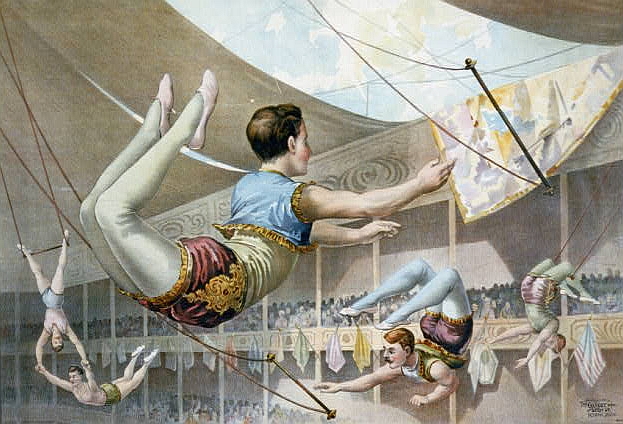
Deborah Digges‟ “Trapeze” summary analysis


Deborah Digges Trapeze
Trapeze
By Deborah Digges
File:Trapeze artists 1890.jpg
See how the first dark takes the city in its arms1
And carries it into what yesterday we called the future.

O, the dying are such acrobats.
Here you must take a boat from one day to the next,

Or clutch the girders of the bridge, hand over hand.
But they are sailing like a pendulum2 between eternity and evening,

Diving, recovering, balancing3 the air.
Who can tell at this hour seabirds from starlings,

Wind from revolving doors or currents off the river.
Some are as children on swings pumping higher and higher.

Don't call them back, don't call them4 in for supper.
See, they leave scuff marks like jet trails on the sky.

1: This is personification because the writer describes the dark as a person by giving it arms to hold the city.

2: The writer uses a simile to compare how the two objects sing back and forth.

3: The writer uses rhythm by adding the –ing to the end of the words

4: The writer uses hyperbole because it is exaggerating the emotion on one person.


Setting: The setting of this place would be in a city during the night and somewhere near the ocean.


The speaker of this story would be the darkness and how it takes over the city when the sun has gone to the other side of the planet. The speakers talks about how everything is moving and about the people. The audience would be the town and how the dark hold it’s in its arm once everyone has gone to bed. The writer uses this type of language to get the reader to understand from his side of the story. The purpose of the story is to let peoples know how some cities can be really colorful when all the lights are out and when the sun is gone. The author’s tone of this poem is a tone that seems really nice and kind and just the way she talks about it. Her mood is a happy mood because of the way she compares things and the way she talks about it.

شرح اخر                                                                 
Trapeze
Deborah Digges


See how the first dark takes the city in its arms 
and carries it into what yesterday we called the future. 


O, the dying are such acrobats. 
Here you must take a boat from one day to the next, 


or clutch the girders of the bridge, hand over hand. 
But they are sailing like a pendulum between eternity and evening, 


diving, recovering, balancing the air. 
Who can tell at this hour seabirds from starlings, 


wind from revolving doors or currents off the river. 
Some are as children on swings pumping higher and higher. 


Don't call them back, don't call them in for supper. 
See, they leave scuff marks like jet trails on the sky.


This hit me like a sock in the jaw--it seems to get the mood of a writer who has an intense sense of that all manner of gravity, both natural and moral, has ceased to exist that the material world and the conduct of the population was now free to play, wander , roam, let themselves go into a an vertiginous , all embrace void. These very much resembles Yeats, and the ringing rhetorical and hard edged images resound like "Easter 1916". The difference between the two, of course, is that Yeats' poem was a prophecy, and his poem was apprehensive because everything old was being made new with new uses, new meanings, remolded from a new philosophy. Terrible in the unknown and beautiful in the sense that life processes cannot be stopped, only made into something new , different. Digges gives the feeling of the floor, the sidewalk, the street giving way from under you , that the conditions of conduct are suspended or revoked outright, and that the life goes to an inevitable, ecstatic end. 


Some are as children on swings pumping higher and higher. 


Don't call them back, don't call them in for supper. 
See, they leave scuff marks like jet trails on the sky. 


These last lines get the pitch exactly, the pull toward a personal apocalypse being so strong that the bounds of reason, protocol, faith are undone. It's a seduction to the darkest yearning, to enter a sphere where there is no contradiction, no agitation, no weighted arguments with the balance of one's universe. To become nothing. It's a plea, as well, for the families, the friends, the passers by to cease heroic efforts to prevent the inevitable and accept one's decision to be raptured.The nihilistic lure is overpowering here, and one is made to feel that there is nothing for this speaker to do but to surrender to natural forces, to embrace the inevitable end. 


What gets me in the poem is how it makes the Big Sleep, the Large Nod, the Humongous Nap an attractive state; life consists mostly of temporary problems requiring our wits and ingenuity with which to engineer remedies. It's a wearying task as the years go on, and Digges , it seems to me, writes from a point of view of someone approaching their nadir, the breaking point when what passes for ironic disengagement, the activity of minimizing one's labors in just getting through the day, becomes an encroaching obsession for a permanent solution . The narrator seems envious of the dead, as you say, but I think there's a real desire here to leave this sphere of being. The weightlessness and unboundedness of the dead suggests desire, a deferred longing . The narrator sounds like she is desirous of what the dead get to do in the universe as we understand it, which is nothing. The desire is to do nothing and to be nothing in turn.The foreknowledge that every living thing dies finally crowds the poem like a Bosch painting--one last intense set of indulgences of the human senses, and then ride the sensual tide to a darkness one cannot report back from. This is beautiful, unnerving, slightly scary.


Monday, April 22, 2013

Free Electronic Shakespeare Reader برنامج يحتوي على جميع اعمال شكسبير بالنص الاصلي


Free Electronic Shakespeare Reader

The Free Electronic Shakespeare Reader is a downloadable piece of software that you can install on any Windows computer, and instantly have all of Shakespeare’s 38 plays at your fingertips. No internet connection required; read plays at your leisure on any computer. An excellent study resource for any English Literature student. Provides in-depth full-text searching to all of Shakespeare’s plays.


Special features include

1.       Word Count / Paragraph Count
2.       Full screen mode for easy reading
3.       Full play text searching
4.       Easy navigation
5.       Study Notebook – take notes on a play
6.       Printing
7.       Fast Loading

Twitter Delicious Facebook Digg Stumbleupon Favorites More

 
www.hypersmash.com