www.hypersmash.com

تابعنا على شبكاتنا الإجتماعية

This is default featured post 1 title

Go to Blogger edit html and find these sentences.Now replace these sentences with your own descriptions.This theme is Bloggerized by Lasantha Bandara - Premiumbloggertemplates.com.

This is default featured post 2 title

Go to Blogger edit html and find these sentences.Now replace these sentences with your own descriptions.This theme is Bloggerized by Lasantha Bandara - Premiumbloggertemplates.com.

This is default featured post 3 title

Go to Blogger edit html and find these sentences.Now replace these sentences with your own descriptions.This theme is Bloggerized by Lasantha Bandara - Premiumbloggertemplates.com.

This is default featured post 4 title

Go to Blogger edit html and find these sentences.Now replace these sentences with your own descriptions.This theme is Bloggerized by Lasantha Bandara - Premiumbloggertemplates.com.

This is default featured post 5 title

Go to Blogger edit html and find these sentences.Now replace these sentences with your own descriptions.This theme is Bloggerized by Lasantha Bandara - Premiumbloggertemplates.com.

Showing posts with label Digges. Show all posts

Tuesday, April 23, 2013

Fleur Adcock Immigrant Summary Analyzing


Fleur Adcocks Immigrant
Summary: The poem "Immigrant" was written by the author Fleur Adcock, focusing on her personal experience when migrating from New Zealand to London, England sometimes during the 60s. The poem talks about her 8th month in London on a bridge looking at the pelicans down on the surface of the river. She watched them while describing their awkward motion of ducking their beaks under the water. Adcock then reveals the fact that she is still trying to practice of avoiding her New Zealand accent.
Analyzing: The poems literally talks about her personal experience with Saint James Park's scenery when visiting the place. Adcock used the metaphor "pelicans" with respect to immigrants because pelicans are the "immigrant" birds on the lake trying to cope with the environment and surrounding. This portrays the assimilation process as the author and the pelicans both trying to adapt to the new environment. One person trying to fix her pronunciation while the animals trying to cope with natural environment. The tone of the poem is calm, follows by a description of the activities of the pelicans, which stimulated the reader a sense of 
peace, yet awkward. The poem reflects the processes of immigration and assimilation.


Fleur Adcock (b.1934) is a New Zealander by birth but spent part of her childhood in England, returning to live in London in 1963. She worked as a librarian until 1979 before becoming a freelance writer. She is the author of ten books of poetry and a collected edition of her work, Poems 1960-2000, was published by Bloodaxe in 2000. Recipient of a Cholmondeley Award in 1976 and a New Zealand National Book Award in 1984, she was awarded an OBE in 1996.

The influence of Fleur Adcock's migratory childhood can be traced in her work's exploration of identity. In her poem 'Immigrant' this is specifically an issue of voice as she practices her newly adopted English accent. Several of the poems here examine roots and rootlessness: as she puts it in 'Chippenham', a poem recalling her status as the odd one out in an English classroom, "Who did I think/I was . . .?" Identity is also an issue of gender: in 'The Russian War' a returning uncle claims he'll "be a thing called oral history" but Adcock is acutely aware of those female ancestors whose stories have disappeared, like the silent labouring woman in 'Water'. Her poems often bring to light women's lives that might otherwise be marginalised or forgotten, as in the poignant vignettes of suffering in 'The Soho Hospital for Women'. However, her poems have no air of stridency: her characteristic tone is restrained, rational, conversational. Adcock herself has talked about this poetic strategy: "The tone I feel at home in is one in which I can address people without embarrassing them; I should like them to relax and listen as if to an intimate conversation". ('Not Quite a Statement', Strong Words, Bloodaxe Books, 2000).

Certainly this quality of intimacy is to the fore in her Archive recording. Her reading voice is clear and distinct, striking the consonants with precision and just the faintest hint of her original accent. A particular pleasure are her generous explanations of the poems and the insights she gives into her creative process: apparently "the bath is a very good place for getting inspiration."

Her recording was made on 13 June 2001 at The Audio Workshop, London and was produced by Richard Carrington.
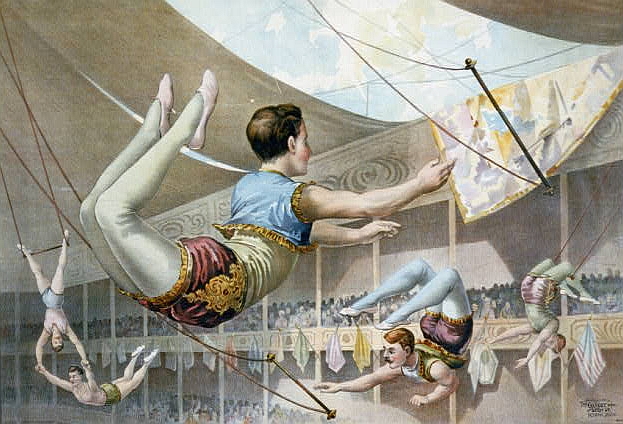
Deborah Digges‟ “Trapeze” summary analysis


Deborah Digges Trapeze
Trapeze
By Deborah Digges
File:Trapeze artists 1890.jpg
See how the first dark takes the city in its arms1
And carries it into what yesterday we called the future.

O, the dying are such acrobats.
Here you must take a boat from one day to the next,

Or clutch the girders of the bridge, hand over hand.
But they are sailing like a pendulum2 between eternity and evening,

Diving, recovering, balancing3 the air.
Who can tell at this hour seabirds from starlings,

Wind from revolving doors or currents off the river.
Some are as children on swings pumping higher and higher.

Don't call them back, don't call them4 in for supper.
See, they leave scuff marks like jet trails on the sky.

1: This is personification because the writer describes the dark as a person by giving it arms to hold the city.

2: The writer uses a simile to compare how the two objects sing back and forth.

3: The writer uses rhythm by adding the –ing to the end of the words

4: The writer uses hyperbole because it is exaggerating the emotion on one person.


Setting: The setting of this place would be in a city during the night and somewhere near the ocean.


The speaker of this story would be the darkness and how it takes over the city when the sun has gone to the other side of the planet. The speakers talks about how everything is moving and about the people. The audience would be the town and how the dark hold it’s in its arm once everyone has gone to bed. The writer uses this type of language to get the reader to understand from his side of the story. The purpose of the story is to let peoples know how some cities can be really colorful when all the lights are out and when the sun is gone. The author’s tone of this poem is a tone that seems really nice and kind and just the way she talks about it. Her mood is a happy mood because of the way she compares things and the way she talks about it.

شرح اخر                                                                 
Trapeze
Deborah Digges


See how the first dark takes the city in its arms 
and carries it into what yesterday we called the future. 


O, the dying are such acrobats. 
Here you must take a boat from one day to the next, 


or clutch the girders of the bridge, hand over hand. 
But they are sailing like a pendulum between eternity and evening, 


diving, recovering, balancing the air. 
Who can tell at this hour seabirds from starlings, 


wind from revolving doors or currents off the river. 
Some are as children on swings pumping higher and higher. 


Don't call them back, don't call them in for supper. 
See, they leave scuff marks like jet trails on the sky.


This hit me like a sock in the jaw--it seems to get the mood of a writer who has an intense sense of that all manner of gravity, both natural and moral, has ceased to exist that the material world and the conduct of the population was now free to play, wander , roam, let themselves go into a an vertiginous , all embrace void. These very much resembles Yeats, and the ringing rhetorical and hard edged images resound like "Easter 1916". The difference between the two, of course, is that Yeats' poem was a prophecy, and his poem was apprehensive because everything old was being made new with new uses, new meanings, remolded from a new philosophy. Terrible in the unknown and beautiful in the sense that life processes cannot be stopped, only made into something new , different. Digges gives the feeling of the floor, the sidewalk, the street giving way from under you , that the conditions of conduct are suspended or revoked outright, and that the life goes to an inevitable, ecstatic end. 


Some are as children on swings pumping higher and higher. 


Don't call them back, don't call them in for supper. 
See, they leave scuff marks like jet trails on the sky. 


These last lines get the pitch exactly, the pull toward a personal apocalypse being so strong that the bounds of reason, protocol, faith are undone. It's a seduction to the darkest yearning, to enter a sphere where there is no contradiction, no agitation, no weighted arguments with the balance of one's universe. To become nothing. It's a plea, as well, for the families, the friends, the passers by to cease heroic efforts to prevent the inevitable and accept one's decision to be raptured.The nihilistic lure is overpowering here, and one is made to feel that there is nothing for this speaker to do but to surrender to natural forces, to embrace the inevitable end. 


What gets me in the poem is how it makes the Big Sleep, the Large Nod, the Humongous Nap an attractive state; life consists mostly of temporary problems requiring our wits and ingenuity with which to engineer remedies. It's a wearying task as the years go on, and Digges , it seems to me, writes from a point of view of someone approaching their nadir, the breaking point when what passes for ironic disengagement, the activity of minimizing one's labors in just getting through the day, becomes an encroaching obsession for a permanent solution . The narrator seems envious of the dead, as you say, but I think there's a real desire here to leave this sphere of being. The weightlessness and unboundedness of the dead suggests desire, a deferred longing . The narrator sounds like she is desirous of what the dead get to do in the universe as we understand it, which is nothing. The desire is to do nothing and to be nothing in turn.The foreknowledge that every living thing dies finally crowds the poem like a Bosch painting--one last intense set of indulgences of the human senses, and then ride the sensual tide to a darkness one cannot report back from. This is beautiful, unnerving, slightly scary.


Twitter Delicious Facebook Digg Stumbleupon Favorites More

 
www.hypersmash.com