www.hypersmash.com

تابعنا على شبكاتنا الإجتماعية

This is default featured post 1 title

Go to Blogger edit html and find these sentences.Now replace these sentences with your own descriptions.This theme is Bloggerized by Lasantha Bandara - Premiumbloggertemplates.com.

This is default featured post 2 title

Go to Blogger edit html and find these sentences.Now replace these sentences with your own descriptions.This theme is Bloggerized by Lasantha Bandara - Premiumbloggertemplates.com.

This is default featured post 3 title

Go to Blogger edit html and find these sentences.Now replace these sentences with your own descriptions.This theme is Bloggerized by Lasantha Bandara - Premiumbloggertemplates.com.

This is default featured post 4 title

Go to Blogger edit html and find these sentences.Now replace these sentences with your own descriptions.This theme is Bloggerized by Lasantha Bandara - Premiumbloggertemplates.com.

This is default featured post 5 title

Go to Blogger edit html and find these sentences.Now replace these sentences with your own descriptions.This theme is Bloggerized by Lasantha Bandara - Premiumbloggertemplates.com.

Showing posts with label Deborah. Show all posts

Wednesday, April 24, 2013

الفصل الثالث محاكمة هيستر برين


الفصل الثالث

كان فى هندي من الهنود الحمر و كان شكله غريب بس مش لدرجة انهم راح يسبو هستر ويطالعو فيه وكان جمبه رجل ابيض لابس لبس همجي على متحضر و جسمه صغير و كان واضح على وجهه علامات الذكاء و التقدم فى السن وكان واحد من كتوفه اعلى من الثاني. لما هستر شافت هذا الرجل حضنت الطفل لدرجة صار يبكى وما انتبهت لبكائه. وهو طالع لها بنظره عفوية بعدين نظر لها بتمعن و وجهه اسود بس بعدين اتحكم بردة فعله و لما شافها انتبتهت له حط اصباعه على فمه بإشارة لها انها تسكت ولمس كتف واحد واقف جمبه وسئله مين هذي؟ واش حكايتها! الرجل قاله شكلك غريب عن هنا هذى هستر براين الى عملت الفضيحة فى الكنيسة قالة ايوة أنا غريب كنت فى البحر وضعت وهذا الهندي هو الى انقذ حياتى ورجع سئله عن حكياة هستر راح الرجال قاله ان هذى المرأة زوجها واحد انجليزي و ارسلها قبله الى بوسطن و بعدين طلعت الفضيحة وقاله ان البنت الى شايلتها ماهى من زوجها وهى رافضة تعترف مين ابو البنت وقال المفروض ان زوجها يجي عشان يشوف الى صار وهذول الى فى الكنيسة قالو انه فى احد ضحك عليها عشان كذا ماعاقبوها العقاب القاسي واكتفو بأنها توقف عالمنصة دى كل يوم تلات ساعات وتشيل الحرف على صدرها العمر كله.هذى العقوبة حكيمة انها تشيل العار طول عمرها حتى لما تموت راح ينحط الحرف على قبرها لكن يؤسفنى ان شريكها فى الجريمة مارح يوقف معاها لكنه راح ينعرف راح ينعرف راح ينعرف. الرجل شكره ومشي وهستر كانت تطالع له وكئنه مابقى في المكان غيرها وغيره وكانت خايفه من مقابلة الشخص دا.فى احد كان ينادى هستر بس هى ما انتبهت الا لما ناداها مره ثانيه.طالعت هستر فى الى كان يناديها وكان جون وينلسون هو الى ينادي عليها وهو من كبار بوسطن وقالها ان هذا الشخص –اشار لرجل يقف لجواره الى اسمه المنستر ديمزديل- اقنعنى انى مايصير اخليكي تفضحى أسرار قلبك قدام الناس وهذا الرجل طلب انه يكون هو الى يتكلم معاكي ويعرف منك شريكك في هذه الجريمة . المنستر ديمزديل سئها عن شريكها و طلب منها تعترف لكنها قالت انها راح تشيل عارها وعارها حاول يقنعها تعترف لكن هى رفضت وخلص عقابها ورجعت للسجن تانى.

Twelfth Night Act 1 Scene 5 Summary and Analysis


Act I: Scene 5
Summary
In Olivia's house, Maria and Feste, the jester, are exchanging quips. Olivia, she tells him, is piqued because of Feste's absence. She jokingly tells him that Olivia may hang him, but Feste is not intimidated. "Many a good hanging prevents a bad marriage," he retorts. He delights in teasing Maria, whom he is complimenting in mock extravagance when Olivia and her steward, Malvolio, enter.
The two of them are very grave and very serious. Olivia orders Feste away, but Feste stays on, determined to amuse his mistress; he launches into a series of jokes that eventually amuse Olivia, despite her serious mien. But Feste's merriment does not amuse the pompous and humorless Malvolio. Malvolio says that the jester is a weak and sick man, as is his wit. Malvolio's arrogant scorn delights Feste, and he easily parries Malvolio's weak wit and, thereby, impresses Olivia. She tells Malvolio that he is "sick of self-love" and "distempered." Jesters, she says, do not slander; it is their craft, a harmless craft, and that Feste is only reproving Malvolio.
Maria enters and tells them that a fair young man from Duke Orsino has arrived and wishes an interview with Olivia, but that he is being detained by Olivia's uncle, Sir Toby. Olivia's temper flares. She will not be wooed by the duke — nor by anyone else. She doesn't care what the messenger is told; any excuse will do. She wants to see no suitors, she says, and she tells Maria to send the young man away immediately. While Maria and Malvolio are gone, Sir Toby appears. He is drunk, and Feste has a marvellous opportunity to ape Olivia's old uncle's drunken antics. Olivia is amused by Feste's cleverness, and her mood softens; she sends Feste to look after her uncle after he exits. She wants to make sure that nothing serious happens to him in his inebriated condition.
Malvolio enters and tells Olivia that the "fair young man" is indeed "fair" and "young," and that he is, in addition, persistent. Olivia relents and agrees to see the lad — as long as Maria is present. She then veils her face before he enters.
Viola, disguised as Cesario, enters and begins his mission by addressing Olivia with many compliments, while adroitly avoiding answering Olivia's questions about his status and background, for Olivia is very inquisitive about this fair, young "man." Cesario continues, and Olivia at last feels so comfortable with the fellow that she dismisses Maria, and the two of them begin to speak of Duke Orsino and his status as a suitor for Olivia's hand in marriage. Olivia is eventually persuaded to unveil herself, and she presents her beautiful face to Cesario — to which "he" responds playfully and most positively: "Excellently done, if God did all." Cesario then laments that the owner of such beauty is indeed cruel if she would carry her "graces to the grave" and "leave the world no copy." He reassures her of Orsino's love, but Olivia says that she doubts that Orsino's love is of any real depth. He does not truly know her; therefore, he must press his suit no further. Yet, on the other hand, if Cesario wishes to come again, Olivia will be most happy to see him. She hands the young man a purse of money for his troubles, but Cesario refuses it. Indignantly, he says that he is no "fee'd post." He bids Olivia farewell — farewell to her "fair cruelty."
Absolutely intrigued with young Cesario, Olivia calls to Malvolio. She tells him to follow Orsino's messenger and to return a ring that he left behind. She also tells Malvolio to inform Cesario that if the youth returns tomorrow, she will explain in detail why Orsino's suit is impossible.
Olivia has fallen in love. The ring is a ruse; Cesario left no ring. Olivia is merely trying to arrange a rendezvous tomorrow between herself and the handsome young envoy from Duke Orsino.
Analysis
Most elegant houses of this time would include, in addition to a large number of servants of different standings, a person who was considered the official "fool," "jester," or "clown." Many critics make a distinction between these terms, but even Shakespeare uses them indiscriminately. Traditionally, in Renaissance terms, the word clown often referred mainly to rustics such as those found in A Midsummer Night's Dream, and a person such as Feste would more appropriately be termed a "fool" (a court jester). Here, Feste opens the scene with the witty servant Maria, and they are engaged in a verbal sparring match. The two are very well matched; Maria is a mischievous, quick-witted person, and Feste has a mind like quicksilver. The pattern of their verbal humor and interchanges is executed in a rapid give-and-take repartee, which is extremely effective on stage.
The entrance of the Countess Olivia has been long awaited. We have heard about her since the opening scene of the act, and now finally at the end of Act I, she makes her first appearance. We are not disappointed. She is beautiful and poised, and she possesses a commanding presence as she immediately reprimands the clown for his lack of seriousness at a time when she is in mourning. As the scene progresses, we see that Olivia shows great intelligence; she is very adept in verbal skills, she appreciates the magnificent humor of the clown, especially when it is aimed at the dour and grave Malvolio, and she is also very practical in disapproving of her uncle's drunkenness and loud belching. And while she acknowledges that the duke is handsome, wealthy, devoted, learned, and refined — in other words, everything a lady could desire — yet she feels that she cannot love him. Later in the scene, we learn that one of her reasons could be that the duke exhibits extreme melodramatics in his message to Olivia. When Cesario delivers the duke's message that he loves Olivia "with adorations, with fertile tears, / With groans that thunder love, with sighs of fire," this declaration represents gross sentimentality; the phrasing is a perfect description of the rhetorical and superficial nature of Duke Orsino's love.
At her entrance, Olivia immediately instructs someone to "take the fool [Feste] away." She finds him to be a "dry fool" — that is, Olivia is in mourning, and foolery ill becomes her at this time. When the fool asks for permission to prove his lady a fool, she grants him permission to do so, and eventually Olivia appreciates the fool's wit and logic; in fact, she is sharp with Malvolio, who disparages the fool and wonders how his mistress can take delight in such a rascal. Again, Malvolio shows that he has no sense of humor; he constantly tries to keep the entire household in an atmosphere of gravity and oppression. His oppressive melancholy prepares the audience to take great delight in the trick that will be played on him later.
When Cesario arrives at the gate, notice that Olivia will have nothing to do with this messenger. Yet Olivia changes her mind about seeing the messenger when she hears the description of the youth given her by Malvolio, a description which whets her imagination; suddenly she desires very much to see him, but she is not anxious to reveal this in front of the dour Malvolio. Thus, we realize that Olivia's guise of mourning for her brother is only another of the many disguises that are employed during this comedy — that is, Lady Olivia used the excuse of her brother's death as a pretext for singling herself out and making herself interesting, and certainly news of her excessive mourning has been carried throughout the country, as we saw in all the preceding scenes.
When Cesario is admitted, further masks and disguises are used to their fullest. First, Olivia has a veil over her face which disguises her true appearance. Viola herself, of course, is in disguise as the young Cesario and, furthermore, as Cesario, she is playing a part because as Cesario, she has memorized a speech that is to be delivered to Olivia. Then, too, there is an abundance of play on words, constantly emphasizing how Olivia is usurping her own role and that Cesario wants only to present the heart of the message, which is to play on Olivia's heart, and when Cesario finally finishes his speech, he says that he holds an olive, the sign of peace in his hand. Note that "olive" is a derivation of Olivia's name and ultimately, by the end of this scene, Cesario will figuratively hold Olivia in "his" hands, since she will by then be enamored of the youth. Cesario must, of necessity, be a good wooer or else lose favor with Duke Orsino. Therefore, there is such a passionate intensity in his pleading that Olivia is struck not so much by the message (which is trite, old and hackneyed), but by the messenger (who is young, passionate, and good-looking). At the same time, Cesario senses that Olivia is too proud to be wooed by proxy, but he attempts to do so anyway. After the message is delivered, Olivia is oblivious to it, but she is so entranced by the messenger that she offers a purse filled with money. Cesario refuses the gift indignantly; he is no fee-accepting person: "I am no fee'd post, Lady; keep your purse. My master, not myself, lacks recompense."
After Cesario has left, Olivia remembers Cesario's proud declaration: "I am a gentleman." Olivia, in fact, savors remembering Cesario's entire conversation; she is aware that she is falling in love with the "boy," and she wonders if it is possible that Orsino is pretending to be Cesario. Her desire to find out and her desire to see the young "boy" again cause her to perpetrate a ruse to bring the youth back to her. We know that this is a trick; Cesario left no ring behind, but this is the safest way that Olivia can try to persuade the youth to return.
At the end of Act I, Olivia is in a delicious state of incipient love after having rejected the duke's offer of love. She accepts her fate, whatever it may be, and exits, thinking of young Cesario in the warmest terms. The situation is now extremely complicated: Olivia loves a girl (Viola) masquerading as a boy (Cesario), while Duke Orsino loves Olivia, who rejects him, and he is in turn loved by a girl (Viola) who, to the duke, is merely a young man whose company he delights in.


Click here for Twelfth Night Act 1 Scene 3 Summary and Analysis  


Tuesday, April 23, 2013

Fleur Adcock Immigrant Summary Analyzing


Fleur Adcocks Immigrant
Summary: The poem "Immigrant" was written by the author Fleur Adcock, focusing on her personal experience when migrating from New Zealand to London, England sometimes during the 60s. The poem talks about her 8th month in London on a bridge looking at the pelicans down on the surface of the river. She watched them while describing their awkward motion of ducking their beaks under the water. Adcock then reveals the fact that she is still trying to practice of avoiding her New Zealand accent.
Analyzing: The poems literally talks about her personal experience with Saint James Park's scenery when visiting the place. Adcock used the metaphor "pelicans" with respect to immigrants because pelicans are the "immigrant" birds on the lake trying to cope with the environment and surrounding. This portrays the assimilation process as the author and the pelicans both trying to adapt to the new environment. One person trying to fix her pronunciation while the animals trying to cope with natural environment. The tone of the poem is calm, follows by a description of the activities of the pelicans, which stimulated the reader a sense of 
peace, yet awkward. The poem reflects the processes of immigration and assimilation.


Fleur Adcock (b.1934) is a New Zealander by birth but spent part of her childhood in England, returning to live in London in 1963. She worked as a librarian until 1979 before becoming a freelance writer. She is the author of ten books of poetry and a collected edition of her work, Poems 1960-2000, was published by Bloodaxe in 2000. Recipient of a Cholmondeley Award in 1976 and a New Zealand National Book Award in 1984, she was awarded an OBE in 1996.

The influence of Fleur Adcock's migratory childhood can be traced in her work's exploration of identity. In her poem 'Immigrant' this is specifically an issue of voice as she practices her newly adopted English accent. Several of the poems here examine roots and rootlessness: as she puts it in 'Chippenham', a poem recalling her status as the odd one out in an English classroom, "Who did I think/I was . . .?" Identity is also an issue of gender: in 'The Russian War' a returning uncle claims he'll "be a thing called oral history" but Adcock is acutely aware of those female ancestors whose stories have disappeared, like the silent labouring woman in 'Water'. Her poems often bring to light women's lives that might otherwise be marginalised or forgotten, as in the poignant vignettes of suffering in 'The Soho Hospital for Women'. However, her poems have no air of stridency: her characteristic tone is restrained, rational, conversational. Adcock herself has talked about this poetic strategy: "The tone I feel at home in is one in which I can address people without embarrassing them; I should like them to relax and listen as if to an intimate conversation". ('Not Quite a Statement', Strong Words, Bloodaxe Books, 2000).

Certainly this quality of intimacy is to the fore in her Archive recording. Her reading voice is clear and distinct, striking the consonants with precision and just the faintest hint of her original accent. A particular pleasure are her generous explanations of the poems and the insights she gives into her creative process: apparently "the bath is a very good place for getting inspiration."

Her recording was made on 13 June 2001 at The Audio Workshop, London and was produced by Richard Carrington.

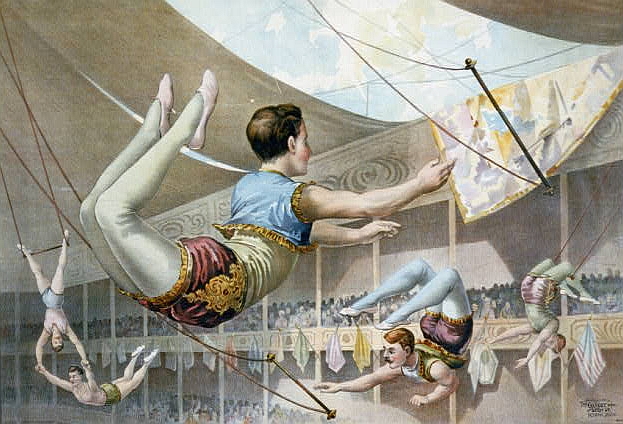
Deborah Digges‟ “Trapeze” summary analysis


Deborah Digges Trapeze
Trapeze
By Deborah Digges
File:Trapeze artists 1890.jpg
See how the first dark takes the city in its arms1
And carries it into what yesterday we called the future.

O, the dying are such acrobats.
Here you must take a boat from one day to the next,

Or clutch the girders of the bridge, hand over hand.
But they are sailing like a pendulum2 between eternity and evening,

Diving, recovering, balancing3 the air.
Who can tell at this hour seabirds from starlings,

Wind from revolving doors or currents off the river.
Some are as children on swings pumping higher and higher.

Don't call them back, don't call them4 in for supper.
See, they leave scuff marks like jet trails on the sky.

1: This is personification because the writer describes the dark as a person by giving it arms to hold the city.

2: The writer uses a simile to compare how the two objects sing back and forth.

3: The writer uses rhythm by adding the –ing to the end of the words

4: The writer uses hyperbole because it is exaggerating the emotion on one person.


Setting: The setting of this place would be in a city during the night and somewhere near the ocean.


The speaker of this story would be the darkness and how it takes over the city when the sun has gone to the other side of the planet. The speakers talks about how everything is moving and about the people. The audience would be the town and how the dark hold it’s in its arm once everyone has gone to bed. The writer uses this type of language to get the reader to understand from his side of the story. The purpose of the story is to let peoples know how some cities can be really colorful when all the lights are out and when the sun is gone. The author’s tone of this poem is a tone that seems really nice and kind and just the way she talks about it. Her mood is a happy mood because of the way she compares things and the way she talks about it.

شرح اخر                                                                 
Trapeze
Deborah Digges


See how the first dark takes the city in its arms 
and carries it into what yesterday we called the future. 


O, the dying are such acrobats. 
Here you must take a boat from one day to the next, 


or clutch the girders of the bridge, hand over hand. 
But they are sailing like a pendulum between eternity and evening, 


diving, recovering, balancing the air. 
Who can tell at this hour seabirds from starlings, 


wind from revolving doors or currents off the river. 
Some are as children on swings pumping higher and higher. 


Don't call them back, don't call them in for supper. 
See, they leave scuff marks like jet trails on the sky.


This hit me like a sock in the jaw--it seems to get the mood of a writer who has an intense sense of that all manner of gravity, both natural and moral, has ceased to exist that the material world and the conduct of the population was now free to play, wander , roam, let themselves go into a an vertiginous , all embrace void. These very much resembles Yeats, and the ringing rhetorical and hard edged images resound like "Easter 1916". The difference between the two, of course, is that Yeats' poem was a prophecy, and his poem was apprehensive because everything old was being made new with new uses, new meanings, remolded from a new philosophy. Terrible in the unknown and beautiful in the sense that life processes cannot be stopped, only made into something new , different. Digges gives the feeling of the floor, the sidewalk, the street giving way from under you , that the conditions of conduct are suspended or revoked outright, and that the life goes to an inevitable, ecstatic end. 


Some are as children on swings pumping higher and higher. 


Don't call them back, don't call them in for supper. 
See, they leave scuff marks like jet trails on the sky. 


These last lines get the pitch exactly, the pull toward a personal apocalypse being so strong that the bounds of reason, protocol, faith are undone. It's a seduction to the darkest yearning, to enter a sphere where there is no contradiction, no agitation, no weighted arguments with the balance of one's universe. To become nothing. It's a plea, as well, for the families, the friends, the passers by to cease heroic efforts to prevent the inevitable and accept one's decision to be raptured.The nihilistic lure is overpowering here, and one is made to feel that there is nothing for this speaker to do but to surrender to natural forces, to embrace the inevitable end. 


What gets me in the poem is how it makes the Big Sleep, the Large Nod, the Humongous Nap an attractive state; life consists mostly of temporary problems requiring our wits and ingenuity with which to engineer remedies. It's a wearying task as the years go on, and Digges , it seems to me, writes from a point of view of someone approaching their nadir, the breaking point when what passes for ironic disengagement, the activity of minimizing one's labors in just getting through the day, becomes an encroaching obsession for a permanent solution . The narrator seems envious of the dead, as you say, but I think there's a real desire here to leave this sphere of being. The weightlessness and unboundedness of the dead suggests desire, a deferred longing . The narrator sounds like she is desirous of what the dead get to do in the universe as we understand it, which is nothing. The desire is to do nothing and to be nothing in turn.The foreknowledge that every living thing dies finally crowds the poem like a Bosch painting--one last intense set of indulgences of the human senses, and then ride the sensual tide to a darkness one cannot report back from. This is beautiful, unnerving, slightly scary.


Twitter Delicious Facebook Digg Stumbleupon Favorites More

 
www.hypersmash.com