www.hypersmash.com

تابعنا على شبكاتنا الإجتماعية

This is default featured post 1 title

Go to Blogger edit html and find these sentences.Now replace these sentences with your own descriptions.This theme is Bloggerized by Lasantha Bandara - Premiumbloggertemplates.com.

This is default featured post 2 title

Go to Blogger edit html and find these sentences.Now replace these sentences with your own descriptions.This theme is Bloggerized by Lasantha Bandara - Premiumbloggertemplates.com.

This is default featured post 3 title

Go to Blogger edit html and find these sentences.Now replace these sentences with your own descriptions.This theme is Bloggerized by Lasantha Bandara - Premiumbloggertemplates.com.

This is default featured post 4 title

Go to Blogger edit html and find these sentences.Now replace these sentences with your own descriptions.This theme is Bloggerized by Lasantha Bandara - Premiumbloggertemplates.com.

This is default featured post 5 title

Go to Blogger edit html and find these sentences.Now replace these sentences with your own descriptions.This theme is Bloggerized by Lasantha Bandara - Premiumbloggertemplates.com.

Showing posts with label Critical. Show all posts

Tuesday, April 30, 2013

Doll’s House By Henrik Ibsen critical theory part 1


 A Doll’s House
 By

Henrik Ibsen


Context

HENRIK IBSEN, considered by many to be the father of modern prose drama, was born in Skien, Norway, on March 20, 1828. He was the second of six children. Ibsen’s father was a prominent merchant, but he went bankrupt when Ibsen was eight years old, so Ibsen spent much of his early life living in poverty. From 1851 to 1864, he worked in theaters in Bergen and in what is now Oslo (then called Christiania). At age twenty-one, Ibsen wrote his first play, a five-act tragedy called Catiline. Like much of his early work, Catiline was written in verse.

In 1858, Ibsen married Suzannah Thoreson, and eventually had one son with her. Ibsen felt that, rather than merely live together, husband and wife should live as equals, free to become their own human beings. (This belief can be seen clearly in A Doll’s House.) Consequently, Ibsen’s critics attacked him for failing to respect the institution of marriage. Like his private life, Ibsen’s writing tended to stir up sensitive social issues, and some corners of Norwegian society frowned upon his work. Sensing criticism in Oslo about not only his work but also his private life, Ibsen moved to Italy in 1864 with the support of a traveling grant and a stipend from the Norwegian government. He spent the next twenty-seven years living abroad, mostly in Italy and Germany.
Ibsen’s early years as a playwright were not lucrative, but he did gain valuable experience during this time. In 1866, Ibsen published his first major theatrical success, a lyric drama called Brand. He followed it with another well-received verse play, Peer Gynt. These two works helped solidify Ibsen’s reputation as one of the premier Norwegian dramatists of his era. In 1879, while living in Italy, Ibsen published his masterpiece, A Doll’s House. Unlike Peer Gynt and Brand, A Doll’s House was written in prose. It is widely considered a landmark in the development of what soon became a highly prevalent genre of theater—realism, which strives to portray life accurately and shuns idealized visions of it. In A Doll’s House, Ibsen employs the themes and structures of classical tragedy while writing in prose about everyday, unexceptional people. A Doll’s House also manifests Ibsen’s concern for women’s rights, and for human rights in general.
Ibsen followed A Doll’s House with two additional plays written in an innovative, realistic mode: Ghosts, in 1881, and An Enemy of the People, in 1882. Both were successes. Ibsen began to gain international recognition, and his works were produced across Europe and translated into many different languages.
In his later work, Ibsen moved away from realistic drama to tackle questions of a psychological and subconscious nature. Accordingly, symbols began to gain prominence in his plays. Among the works he wrote in this symbolist period are The Wild Duck (1884) and Hedda Gabler (1890). Hedda Gabler was the last play Ibsen wrote while living abroad. In 1891, he returned to Oslo. His later dramas include The Master Builder (1892) and Little Eyolf (1896). Eventually, a crippling sickness afflicted Ibsen and prevented him from writing. He died on May 23, 1906


Plot Overview
A DOLL’S HOUSE opens on Christmas Eve. Nora Helmer enters her well-furnished living room—the setting of the entire play—carrying several packages. Torvald Helmer, Nora’s husband, comes out of his study when he hears her arrive. He greets her playfully and affectionately, but then chides her for spending so much money on Christmas gifts. Their conversation reveals that the Helmers have had to be careful with money for many years, but that Torvald has recently obtained a new position at the bank where he works that will afford them a more comfortable lifestyle.

Helene, the maid, announces that the Helmers’ dear friend Dr. Rank has come to visit. At the same time, another visitor has arrived, this one unknown. To Nora’s great surprise, Kristine Linde, a former school friend, comes into the room. The two have not seen each other for years, but Nora mentions having read that Mrs. Linde’s husband passed away a few years earlier. Mrs. Linde tells Nora that when her husband died, she was left with no money and no children. Nora tells Mrs. Linde about her first year of marriage to Torvald. She explains that they were very poor and both had to work long hours. Torvald became sick, she adds, and the couple had to travel to Italy so that Torvald could recover

Nora inquires further about Mrs. Linde’s life, and Mrs. Linde explains that for years she had to care for her sick mother and her two younger brothers. She states that her mother has passed away, though, and that the brothers are too old to need her. Instead of feeling relief, Mrs. Linde says she feels empty because she has no occupation; she hopes that Torvald may be able to help her obtain employment. Nora promises to speak to Torvald and then reveals a great secret to Mrs. Linde—without Torvald’s knowledge, Nora illegally borrowed money for the trip that she and Torvald took to Italy; she told Torvald that the money had come from her father. For years, Nora reveals, she has worked and saved in secret, slowly repaying the debt, and soon it will be fully repaid.
Krogstad, a low-level employee at the bank where Torvald works, arrives and proceeds into Torvald’s study. Nora reacts uneasily to Krogstad’s presence, and Dr. Rank, coming out of the study, says Krogstad is “morally sick.” Once he has finished meeting with Krogstad, Torvald comes into the living room and says that he can probably hire Mrs. Linde at the bank. Dr. Rank, Torvald, and Mrs. Linde then depart, leaving Nora by herself. Nora’s children return with their nanny, Anne-Marie, and Nora plays with them until she notices Krogstad’s presence in the room. The two converse, and Krogstad is revealed to be the source of Nora’s secret loan.
Krogstad states that Torvald wants to fire him from his position at the bank and alludes to his own poor reputation. He asks Nora to use her influence to ensure that his position remains secure. When she refuses, Krogstad points out that he has in his possession a contract that contains Nora’s forgery of her father’s signature. Krogstad blackmails Nora, threatening to reveal her crime and to bring shame and disgrace on both Nora and her husband if she does not prevent Torvald from firing him. Krogstad leaves, and when Torvald returns, Nora tries to convince him not to fire Krogstad, but Torvald will hear nothing of it. He declares Krogstad an immoral man and states that he feels physically ill in the presence of such people.
Act Two opens on the following day, Christmas. Alone, Nora paces her living room, filled with anxiety. Mrs. Linde arrives and helps sew Nora’s costume for the ball that Nora will be attending at her neighbors’ home the following evening. Nora tells Mrs. Linde that Dr. Rank has a mortal illness that he inherited from his father. Nora’s suspicious behavior leads Mrs. Linde to guess that Dr. Rank is the source of Nora’s loan. Nora denies Mrs. Linde’s charge but refuses to reveal the source of her distress. Torvald arrives, and Nora again begs him to keep Krogstad employed at the bank, but again Torvald refuses. When Nora presses him, he admits that Krogstad’s moral behavior isn’t all that bothers him—he dislikes Krogstad’s overly familiar attitude. Torvald and Nora argue until Torvald sends the maid to deliver Krogstad’s letter of dismissal.
Torvald leaves. Dr. Rank arrives and tells Nora that he knows he is close to death. She attempts to cheer him up and begins to flirt with him. She seems to be preparing to ask him to intervene on her behalf in her struggle with Torvald. Suddenly, Dr. Rank reveals to Nora that he is in love with her. In light of this revelation, Nora refuses to ask Dr. Rank for anything.
Once Dr. Rank leaves, Krogstad arrives and demands an explanation for his dismissal. He wants respectability and has changed the terms of the blackmail: he now insists to Nora that not only that he be rehired at the bank but that he be rehired in a higher position. He then puts a letter detailing Nora’s debt and forgery in the -Helmers’ letterbox. In a panic, Nora tells Mrs. Linde everything, and Mrs. Linde instructs Nora to delay Torvald from opening the letter as long as possible while she goes to speak with Krogstad. In order to distract Torvald from the letterbox, Nora begins to practice the tarantella she will perform at that evening’s costume party. In her agitated emotional state, she dances wildly and violently, displeasing Torvald. Nora manages to make Torvald promise not to open his mail until after she performs at the party. Mrs. Linde soon returns and says that she has left Krogstad a note but that he will be gone until the following evening.
The next night, as the costume party takes place upstairs, Krogstad meets Mrs. Linde in the Helmers’ living room. Their conversation reveals that the two had once deeply in love, but Mrs. Linde left Krogstad for a wealthier man who would enable her to support her family. She tells Krogstad that now that she is free of her own familial obligations and wishes to be with Krogstad and care for his children. Krogstad is overjoyed and says he will demand his letter back before Torvald can read it and learn Nora’s secret. Mrs. Linde, however, insists he leave the letter, because she believes both Torvald and Nora will be better off once the truth has been revealed.
Soon after Krogstad’s departure, Nora and Torvald enter, back from the costume ball. After saying goodnight to Mrs. Linde, Torvald tells Nora how desirable she looked as she danced. Dr. Rank, who was also at the party and has come to say goodnight, promptly interrupts Torvald’s advances on Nora. After Dr. Rank leaves, Torvald finds in his letterbox two of Dr. Rank’s visiting cards, each with a black cross above the name. Nora knows Dr. Rank’s cards constitute his announcement that he will soon die, and she informs Torvald of this fact. She then insists that Torvald read Krogstad’s letter.
Torvald reads the letter and is outraged. He calls Nora a hypocrite and a liar and complains that she has ruined his happiness. He declares that she will not be allowed to raise their children. Helene then brings in a letter. Torvald opens it and discovers that Krogstad has returned Nora’s contract (which contains the forged signature). Overjoyed, Torvald attempts to dismiss his past insults, but his harsh words have triggered something in Nora. She declares that despite their eight years of marriage, they do not understand one another. Torvald, Nora asserts, has treated her like a “doll” to be played with and admired. She decides to leave Torvald, declaring that she must “make sense of [her]self and everything around her.” She walks out, slamming the door behind her.


Friday, April 26, 2013

Thomas Wyatt Hind analysis


Thomas Wyatt


Hind


A Complete Interpretation (New Criticism Approach)


Whoso list to hunt powerfully exemplifies the artistic skills of Sir Thomas Wyatt in Sonnet, which decorated with deep emotions and initiate use of literary devices. To England sonnet was introduced by Wyatt who was a diplomat in Italy, the birth place of sonnet and renascence, for some time. Sonnet during 13 to 16 century was the best and appropriate form of poetry at first for love subject; later for variety of subjects even nature in romantic period. Wyatt was in love with a woman by the name of Anne Boleyn, but the king of the time, Henry VIII, defeated him and won her before him. Thereafter he realized that he can't do anything about it because his opponent was the king. Later it is said she had done adultery with Wyatt; the king imprisoned Wyatt beheading Anne Boleyn. In this sonnet Wyatt with a very deep sorrow express his pure love toward Anne, and how all the rumors about her were nothing, but calumny. 
The form of this sonnet is petrarchan with rhyme scheme (ABBA-ABBA-CDDC -EE). Wyatt used Petrarchan sonnet form sometimes with a slight change in its rhyme scheme, he divided sonnet into three four lines stanzas and two last lines, 13th and 14thl lines, as couplet. The meter of this sonnet is iambic pentameter. The word choice, imaginary language, end-jumpment, grammatical disorder techniques, alliteration that makes the sonnet more musical, and metaphors that are used in this sonnet, make it more expressive and rich. The poet utilized first person point of view, using the pronouns I and me. It has three major themes  1power and weakness, or ruler and subjects, 2 unreachable goal, 3unreachable love. In power and weakness the theme is about how the king can do and have whatever he wants and the subjects should obey without any complain. The next theme, unreachable goal, points out how man struggle to get to something unreachable although he knows he can't. The third theme, unreachable love, shows the speaker is in love with a lady which is in king possession. The tone of this work is hopelessness.
The title is repeated in the very first line of the sonnet like a clause of a long sentence, and the rest of the sonnet serves as complement. It is an exposition question means Whoever desires to hunt it really hooks the reader mind to see what the answer is. The word whoso means whoever;  list means desire, want, need; Hunt means chase, pursuit, and search.
In the first line 1 Wyatt introduces the reader to a metaphors used for the intended women, and hunt for wanting her. Whoso list to hunt,          I know where is an hind means whoever desires to hunt, I know a female deer. The hind here metaphorically refers to a lady. The words hind, doe, and gazelle in western literature metaphorically refer to beautiful women. These metaphors in the first line serve as the chief metaphors in the sonnet; the subject discuss around this subject until the end. The first line contains alliteration, too (whoso, hunt, hind). In line 2-3 the speaker describes himself as a hunter moaning his tiredness caused by vain attempt to hunt the deer. Line 2 and 3 also employ alliteration (me, may, more) and (so, sore). But as for me, helas, I may no more;  the vain travail hath wearied me so sore.  He says that he feels so sorry, for all his attempt were in vain to win her love and be united with her; now he is so wearied and sore( Haim Dictionary sore can be used for mental tiredness, too). The pronoun them in line 4 refers to the other hunters, men who were trying to win the lady's love. Lines 4-6 the speaker notes that although he fall behind than other hunters, he cannot take her out of his mind, and she eludes to be caught by the hunters. Fleet afore means escaping, running away far ahead. The lady running away from her lovers shows chasteness of her and how she isn't interested in them. Again in line 5 and 6 again alliteration is noticeable (may, means, my, mind).In line 7 he says since the deer runs ahead, he is losing hope to get to her (fainting, follow) is alliteration, fainting means hopeless, not intense. In the second half of line 7 he says he gives up because (Line 8) he realizes that all his struggles are in vain giving a proverb as an example, catching wind with a net; This metaphor illustrate the themes of the sonnet . In (line 9) another alliteration is visible (whoso, her, hunt). (Line 9) I Put him out of doubt means assure, guarantee. (Line 9-10) The speaker says the one who is trying to hunt the deer; I assure him his efforts will be in vain just like his. (Line 11) Graven means carved; diamonds diamonds are hard, bright precious stones. It is carved with diamond clearly, or frankly. (Line 12) means there around her beautiful neck it is written, visible to everyone. (Line 13) the poet used here an allusion in Latin taken from the bible.  Noli me tangere in English means don't touch me. it is a warning; like stay away from me. (Line 14) the word  Wild  means free, and rough showing she needed to be caught by a skillful strong hunter; tame means amenable. She says; you may fancy catching me since I seem tame, but in reality having me is impractical. In this line employs a paradox  wild for to hold, though I seem to tame.  There is a contradiction between words wild and tame. This paradox illustrates the attitude of the lady toward her lovers and how she neglects them. It also provides answer to the problem raised in octave. Diamonds are symbols of asset, and wealth; it makes clear two things. First, the lady is kings property and no one is allowed to covet her; second, the king is rich and already paid the price for her. 
Sir Thomas Wyatt in whoso list to hunt a metaphorical sonnet using his extraordinary talent telling his life story, how men are trying to have a lady who doesn't pay attention to them because she belongs to the king. Images, paradox, and alliterations all these make the sonnet more beautiful and musical. Any reader, by reading this sonnet, will sympathize with Wyatt and his unsuccessful and unreachable love.

Tuesday, April 23, 2013

English Literature الادب الانجليزي 3


images (259×194)

واهتم كتّاب آخرون في هذه الحقبة أيضاً، بعد الغزو النورمندي، وهم الكتاب 
الأنكلو-نورمنديون بالكتابات التعليمية الواعظة، ورأوا فيها مادة للشعر بدلاً من القصص البطولية الدنيوية. وظهرت مجموعة من الكتب تتحدث عن الأخلاق مثل كتابات روبرت مانينغ Robert Mannyng وكتاب «وخز الضمير» The Pricke of Conscience (القرن 14) المجهول المؤلف وهو دليل للمواعظ. وكتبت في هذه الحقبة أيضاً أشعار الحب وقصائد غنائية كثيرة اتجهت لاستخدام اللغة المحكية والجناس. ولعل أهم شاعرين في هذا المجال هما وليم 
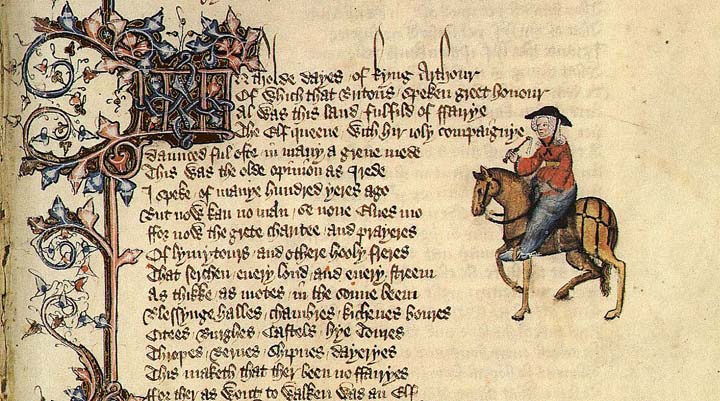
lit.jpg (720×401)

لانغلند(1330-1386)William Langland الذي كتب قصيدته الشعرية الطويلة «رؤية بيرس الحارث»(1367) Vision of Piers Plowmanالتي تتحدث عن مشكلات الطبقة الفقيرة في القرن الرابع عشر في إنكلترة، وشاعر غوين Gawain Poet المجهول الاسم والذي عُرف بهذا اللقب أخذاً عن أسطورته الشعرية «السير غوين والفارس الأخضر» (1375) SirGawain and The Green Knight، وكتب قصائد دينة مثل «اللؤلؤة» The Pearl و«الطهارة»Purity و«الصبر»Patience. إلا أن هـذا النوع من الشعر لم يتطور إلى مدرسة يقتدي بها الشعراء من بعدهما وذلك لصعوبة اللغة التي استخدماها. وكان للشاعر الكبير جفري تشوسر[ر] Chaucer أن يضع حجر الأساس للغة الإنكليزية وآدابها بعد أن كتب باللغة المحكية التي يفهمها القارئ اليوم مع ما طرأ عليها من تغيرات، وبهذا صار أهم كاتب في هذه الحقبة وصار مدرسة في حد ذاته. إذ كتب الكثير من الأعمال كان أهمها «حكايات كانتربري» Canterbury Tales. وقد حافظ الشعراء والكتاب الذين جاؤوا من بعد تشوسر على ما بدأه بكتاباتهم باللغة المحكية، ويذكر من هؤلاء على سبيل المثال لا الحصر الكاتب ورجل الدولة توماس مور(1477- 1535)Thomas More الذي جاء في أوائل عصر النهضة وكتب «يوتوبيا» (أو المدينة الفاضلة)(1516) Utopiaوأثر بها في الكثير من الكتاب في عصره وما بعده. وهي مجموعة مقالات صارت فيما بعد مرجعاً للمذهب الإنساني الذي أسسه المفكر الهولندي إراسموس[ر] Erasmus وتابعه فيه المفكرون في القارة الأوربية إبان عصر النهضة.

انتهى الموضوع بعونه تعالى

Monday, April 22, 2013

"Analysis on John Donne’s "Death Be Not Proud 1572-1631


"Analysis on John Donne’s "Death Be Not Proud


Death Be Not Proud

by John Donne

(1572-1631)

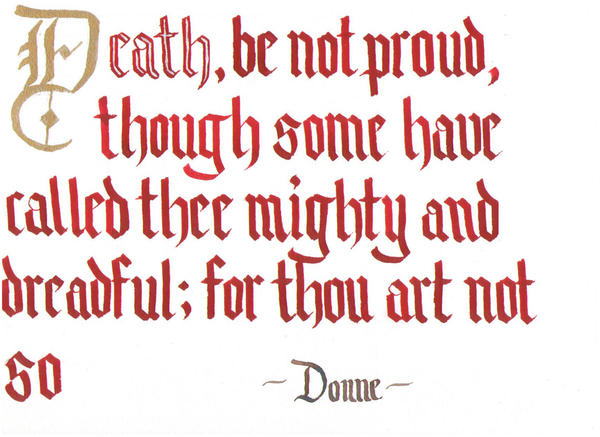
DEATH be not proud, though some have called thee

Mighty and dreadfull, for, thou art not so,
For, those, whom thou think’st, thou dost overthrow,
Die not, poore death, nor yet canst thou kill me.
From rest and sleepe, which but thy pictures bee,
Much pleasure, then from thee, much more must flow,
And soonest our best men with thee doe goe,
Rest of their bones, and soules deliverie.
Thou art slave to Fate, Chance, kings, and desperate men,
And dost with poyson, warre, and sicknesse dwell,
And poppie, or charmes can make us sleepe as well,
And better then thy stroake; why swell’st thou then;
One short sleepe past, wee wake eternally,
And death shall be no more; death, thou shalt die. 


Derick Ariyam
November 21, 2005


A Critical Analysis of “Death Be Not Proud” by John Donne


The sonnet “Death Be Not Proud”, written by John Donne around the year 1618, is one of many sonnets that are part of a collection called The Holy Sonnets. This collection is comprised of nineteen sonnets with themes that pertain to Christian philosophy. 


“Death Be Not Proud” is a powerful declaration against death, in which death is personified as a tyrant without real power “…some have called thee / Mighty and dreadfull, for, thou art not soe” (1-2). The poem continues to dismantle death from something mysterious and feared, to something weak and irrelevant. The speaker’s main polemic is grounded in the beliefs of Christian philosophy, in particular, its promise of eternal life. But prior to this, the poem dismantles death from secular angles as well.


From a structural standpoint, the poem tightly adheres to the sonnet form, which is defined as a lyric poem that adheres to a conventional rhyme scheme and is usually made up of fourteen lines (Murfin, Ray 450). The rhyme scheme for this poem is “abbaabbacddcee”. 


The poem attacks death from two different angles: a secular angle and a religious angle. The first twelve lines are mostly secular in the sense that a non-Christian can at least follow the argument. The last two lines require a belief in Christianity, and with this belief, comes the more powerful, irrefutable claim, dramatically stated in the words “And death shall be no more; Death, thou shalt die”(14), which pertains to the Christian concept of Eternal Life. 


The first angle, the secular, the speaker starts with a feeling of disdain and loathing in the words used against death, creating an immediate pejorative connotation with this character. This is followed by flippancy and mocking: “Die not, poore Death, nor yet canst thou kill me” (4). Here the words “poore Death” are used to diminish Death’s formidability. 


This line follows with another that has the same enervating effect, “From rest and sleep, which but thy pictures be, / Much pleasure; then from thee much more most flow” (5-6). Here the speaker, using logic, is stating that since death appears outwardly to be merely a sleep, and sleep being a pleasurable thing, death must be even more pleasurable. 


Flippancy and mocking is then turned into disarmament as the speaker addresses Death as a slave, at the whim of external influences, “Thou art slave to Fate, Chance, kings, and desperate men” (9). This line intimates that death has no real power, but is merely summoned like an instrument without complete autonomy of its own will.


The last part of the poem, particularly in the last two lines, forms the more powerful and convincing argument against the fortitude of death; however, it requires a belief in Christianity.


According to Christian philosophy, those that believe in Christ will never die but live eternally, "That whosoever believeth in him should not perish, but have eternal life" (John. 3.15 King James Version). This is not to imply that believers escape the natural course of all living things, which is to eventually cease from living, to die; death to Christians is not a ceasing of life, but rather, an entering into life, a better life, an eternal life. In essence, the earthly perishable body is left behind and the soul continues to live forever thereby escaping death: 


"So when this corruptible shall have put on incorruption, and this mortal shall have put on immortality, then shall be brought to pass the saying that is written, Death is swallowed up in victory" (1 Cor. 15.54).


In the aforementioned passage from the King James Version of the Bible, Saint Paul, in his letter to the Corinthians, again reiterates the Christian faith’s view of death as something “irrelevant”, a similar view that is taken in John Donne’s sonnet “Death Be Not Proud”.


The last line of the poem is the final thrust against death. It is a claim that death is meaningless, and a paradox. This is written as a recursive statement “…death, thou shalt die”(14). Since there is no death, the only thing left is Eternal Life. 


But this poem is not merely a remonstration; it is also a passionate piece of writing that is imbued with emotion and sounds. Starting from the first line, “Death be not proud, though some have called thee / Mighty and dreadful, for thou art not so” (1-2), the words that are chosen and their placement, adds a peremptory tone to this first declaration; these are lines that can not be whispered, but rather, belched out sonorously. 


The entire poem follows in this manner, as a declaration loudly commanded. This continues up until the last lines of the sonnet, where the tone shifts to that of “finality”, “And death shall be no more; Death, thou shalt die” (14). Also, many of the words in this poem bear heavy connotations, “Thou are slave to Fate, Chance, kings, and desperate men” (9), the words “slave” and “desperate” are words with strong emotional connotations. 


“Death Be Not Proud” by John Donne, is a sonnet from the revered Holy Sonnets that passionately argues against the formidability of death. The poem cites the Christian hope of Eternal Life as the ultimate escape from death, but does provide secular arguments as well that work in lightening the concept of death. But beyond this, the sonnet is a literary work of 
immense beauty and structure; it is a brilliant work from any point-of-view.

Twitter Delicious Facebook Digg Stumbleupon Favorites More

 
www.hypersmash.com