www.hypersmash.com

تابعنا على شبكاتنا الإجتماعية

This is default featured post 1 title

Go to Blogger edit html and find these sentences.Now replace these sentences with your own descriptions.This theme is Bloggerized by Lasantha Bandara - Premiumbloggertemplates.com.

This is default featured post 2 title

Go to Blogger edit html and find these sentences.Now replace these sentences with your own descriptions.This theme is Bloggerized by Lasantha Bandara - Premiumbloggertemplates.com.

This is default featured post 3 title

Go to Blogger edit html and find these sentences.Now replace these sentences with your own descriptions.This theme is Bloggerized by Lasantha Bandara - Premiumbloggertemplates.com.

This is default featured post 4 title

Go to Blogger edit html and find these sentences.Now replace these sentences with your own descriptions.This theme is Bloggerized by Lasantha Bandara - Premiumbloggertemplates.com.

This is default featured post 5 title

Go to Blogger edit html and find these sentences.Now replace these sentences with your own descriptions.This theme is Bloggerized by Lasantha Bandara - Premiumbloggertemplates.com.

Showing posts with label Trapeze. Show all posts

Thursday, April 25, 2013

Ode to Evening


Ode to Evening


The Poem
“Ode to Evening,” a single stanza of fifty-two lines, is addressed to a goddess figure representing the time of
day in the title. This “nymph,” or “maid,” who personifies dusk, is “chaste,” “reserv’d,” and meek, in
contrast to the “bright-hair’d sun,” a male figure who withdraws into his tent, making way for night. Thus
“Eve,” or evening, is presented as the transition between light and darkness.
William Collins further stresses a female identity in his appellation “calm vot’ress.” With this feminine form
of “votary” he designates a nun, or one who vows to follow the religious life. This combination of modesty,
devotion, and “pensive Pleasures” alludes to the dominating figure of John Milton’s “Il Penseroso.”
The poem has three parts: the opening salutation, locating Eve in sequence and in the countryside; the center,
a plea for guidance in achieving a calm stoicism, with a qualification, showing the reason for the request, and
a shift to a personal view-point; and a grand finale with a roll call of the seasons and a return to a universal
dimension.
Throughout most of the poem, Collins acknowledges Eve’s authority and twilight’s pleasures, combining
pastoral imagery with classical allusions. These give the poem a Miltonic overtone, familiar to readers of
Collins’s day, and a close connection to his contemporaries, such as James Thomson and Joseph Warton.
After the opening apostrophe to Eve, nature takes over the first section (lines 3-14), with images of water in
references to “solemn springs” plus the sun’s “cloudy skirts” and “wavy bed.” The wind plays a small part
in setting the scene with only the one reference to “dying gales” subsiding to the point where “air is
hush’d.” An allusion to John Milton’s “Lycidas” appears in the auditory image which invades the stillness
in these lines: “Now air is hush’d, save where the weak-ey’d bat,/ With short, shrill shriek flits by on
leathern wing” (lines 9-10). Other noises, less ominous, come from the beetle and the bee, a “pilgrim born in
heedless hum.”
The second part of the poem starts with a request to the “maid compos’d,” who is worthy of emulation.
“Now teach me,” Collins says, to write lines in keeping with the atmosphere Eve creates. The term
“numbers” here stands not only for versification and metrics but also for poetry in general. This section splits
into the prayer itself, the details of evening’s “genial, lov’d return,” and an ominous dimension that makes
the depiction more realistic than the classical allusions do. The signal for return is the appearance of Hesperus,
the evening star. At this point, place deities, termed “Hours,” “elves,” and nymphs, become servants
preparing evening’s chariot for her entrance.
The poet takes center stage here, injecting a view of nature with “chill blustering winds” and “driving rain”
that make him reluctant to follow Eve. A scene reminiscent of William Shakespeare’s King Lear being
exposed to violent weather on the heath is softened with the sound of a church bell.


Finally, the poem presents the cyclical pageant of nature. Starting with a series of images befitting “meekest
Eve” and sharply summarizing each season, the ending brings together the benefits possibly resulting from
devotion to the goddess.
Forms and Devices
Written in imitation of the Roman poet Horace, this poem is considered a Horatian rather than a pastoral ode,
although it contains rural imagery and some conventions associated with pastoral poetry. The verse is
unrhymed, with a metrical pattern developing as follows: alternating sets of two iambic pentameter lines and
two shorter lines of iambic trimeter.
The sequence of longer and shorter couplets is more important for purposes of unity here than it would have
been had the lines been rhyming couplets. Collins’s use of couplets follows the neoclassical tradition, but his
introduction of the short trimeter lines is viewed, in that context, as an aberration. His balancing of long and
short couplets helps to structure a poem considered too short for the verse paragraphs of blank verse and too
long for one stanza. If each four-line set is viewed as a unit, the poem could be divided into thirteen stanzas.
Ultimately, the metrical balance reflects the alternation of day and night, although only a transitional part of
this cycle is the focus of the content and the imagery.
Collins uses conventional neoclassical poetic diction without resorting to extreme or ridiculous phraseology.
One possible exception is the “pilgrim born in heedless hum,” a metaphor for a bee. Primarily, however,
Collins’s metaphors stand on their own merits, sometimes coming close to clichés but not overcome by them.
Language depicting pastoral images, such as “oaten stop,” “yon western tent” of the sun, the “folding star”
of Hesperus, and the mountain and valley landscapes, establish the general tone of the poem and reflect
Collins’s neoclassicism. The Miltonic overlay created by these images, by the imitations of Miltonic style,
and by lines alluding to others by Milton cannot be ignored.
Nature imagery serves to depict how darkness begins to take over the atmosphere without fanfare and
develops a personality for Eve. The combination of these details and the adjectives used to describe Eve, such
as modest, chaste, and meek, creates a comfortable feeling.
The comforts of tone and quiet devotion are driven off, however, by personal references to the poet, who, in
spite of “willing feet,” is hiding inside the “hut,/ That, from the mountain’s side,/ Views wilds, and swelling
floods” (lines 34-36) because of the cold and rainy winds on a suggestively Shakespearean heath. The image
of spring would be overpowered by this picture, despite the sound of the church bell, were it not for the
compelling pictures created for the other seasons in the ending.
Themes and Meanings
Ostensibly, “Ode to Evening” is a nature poem, one of those often considered a prelude to the Romantic
movement or a deliberate and intentional antidote to the heroic genres most prominent in the earlier part of the
Augustan age. The poem looks forward to the Age of Sensibility, a label which poems such as Thomson’s
The Seasons (1730) and Warton’s The Enthusiast: Or, The Love of Nature (1744) helped to create. Collins’s
ode promotes scenic nature, as do these poems, in contrast to the neoclassical emphasis upon human nature.
Similarly, it even hints at the sublime in the section describing the mountain storm and the view from the hut
as well as in the images of winter at the end. Nevertheless, just as evening is neither day nor night, this poem
is neither fully pre-Romantic nor conventionally neoclassical. It is transitional, subtle, and generally quiet,
like its subject.


Even though Collins follows convention in imagery, diction, and verse form, he demonstrates that he is not a
slave to it. The ode exerts the “gentlest” of influences, as its subject does. Even the superlatives Collins uses
are not exaggerations, but the superlative forms of adjectives such as “gentle” and “meek.”
The striking passages are, first, those depicting the prospect of a violent mountain storm as well as attack by
winter on Eve’s entourage and her flowing garments; and second, the images which are more sharply focused
in the pageant of seasons which ends the poem. These seem to establish the grounds for the earlier prayer in
hopes of adopting evening’s calm demeanor and reserved behavior. Especially poignant are the lines
describing how the wind and rain of the storm keep the poet’s “willing feet” from obeying their desire to
follow Eve. These lines seem highly personal in light of Samuel Johnson’s famous phrase describing the
poet, “poor dear Collins.” Contemporaries’ accounts of Collins’s life, including those by his friends, record
mental breakdowns which are entirely relevant if one notes the poet’s own signals in this and other poems.
The allusion to Lear on the heath is not the poet’s personal equation of himself with Shakespeare’s
egotistical king; other characters who join the scene in the hut would be more suitable for comparison with
Collins’s presentation of himself. This passage is a faint echo of feelings expressed in the “Ode to Fear”
from the same volume (1746). Although “Ode to Fear” is generated by Aristotle’s discussion of pity and fear
in his concept of catharsis, the personal element is a noticeable dimension and reinforces a biographical
interpretation for both poems.
The final section ventures into a more vivid style of natural depiction. The fragrances of spring, the length of
summer days, the effect engendered by autumn colors and temperatures are just as compelling as the violence
of winter and are not overpowered by it. The apparent timidity of the earliest passages and the passion tapped
in the heath scene have a purpose within the poem itself: a careful buildup to a final celebration. Collins’s
skillful manipulation of imagery and versification, along with the consequent modulations in tone and
atmosphere, have created a poem representative of both the era and the inventive genius of the individual
poet.



Literary Analysis of Robert Burns's A Red, Red Rose


Literary Analysis of Robert Burns's A Red, Red Rose


Period of English Literature
18th Century England; The Age of Enlightenment; 1796
Historical Background
      Robert Burns is often considered a writer ahead of his time, who often embraced the idea of using common language to reach the common person just slightly before this idea became popularized as the Age of Romanticism swept across the globe.
      When Burns published “A Red, Red Rose” in 1794, the Age of Enlightenment was dwindling to an end.
      Like the Romantics, he stressed emotion, not reason; were concerned with experiencing nature, not understanding it; and allowed for the possibility of an explicable, supernatural world
      His poetry demonstrates the Romantics’ faith in simple, common, accessible language is one of the ideas that was around before the movement in general took root.
      This treatment of time and beauty predicts the work of the later Romantic poets, who took Burns’s work as an important influence.
Type of Work (Form)
Ballad stanza
Ballad: The ballad is an old form of verse adapted for singing or recitation, originating in the days when most poetry existed in spoken rather than written form. The typical subject matter of most ballads reflects folk themes important to common people: love, courage, the mysterious, and the supernatural. Though the ballad is generally rich in musical qualities such as rhythm and repetition, it often portrays both ideas and feelings in overwrought but simplistic terms.

Structure
Composition
·         Four four-line stanzas (or quatrains)
·         The first and third lines of each stanza have four stressed syllables, while the second and fourth lines have three stressed syllables.
Voice
First Person (My, I)
Subject
The speaker’s confession of love and passion to his lover.
Tone
Romantic and melancholy (a deep feeling of sadness)
Themes
·         The transient nature of beauty and love.
·         The delicate and fragile nature of beauty and love.
·         A meditation on the speaker’s consciousness of time and on limits that time can place upon human emotions.
Summary of Poem
The speaker compares his love first with a blooming rose in spring and then with a melody “sweetly play’d in tune.” If these similes seem the typical fodder for love-song lyricists, the second and third stanzas introduce the subtler and more complex implications of time. In trying to quantify his feelings—and in searching for the perfect metaphor to describe the “eternal” nature of his love—the speaker inevitably comes up against love’s greatest limitation, “the sands o’ life.” This image of the hour-glass forces the reader to reassess of the poem’s first and loveliest image: A “red, red rose” is itself an object of an hour, “newly sprung” only “in June” and afterward subject to the decay of time. This treatment of time and beauty predicts the work of the later Romantic poets, who took Burns’s work as an important influence.
Summary of  Lines 1-2
The reader may be already familiar with the poem’s much-quoted first line. Its appeal over time probably stems from the boldness of its assertion— the speaker’s love conveyed through the conventional image of the rose and through the line’s four strong beats. The poet’s choice of a rose may at first seem trite, and the color “red” may seem too obvious a symbol of love and passion. Yet if the comparison between the beloved and the rose verges on cliché, a careful reading reveals the subtler ways in which the speaker expresses his conviction. Why, for instance, is the word “red” repeated? The answer might be found in the second line. While red is the expected hue of the flower, the repetition of the adjective represents the fullest and most lovely manifestation of the rose: its ideal state. Such also is the nature of the speaker’s love. “Newly sprung,” it exists in its purest and most perfect state—none of its vitality has faded; time has not scarred it with age or decay. Yet this embodiment of love is a temporary one. Like the rose, which can exist in this lush form only “in June,” the speaker’s feelings and his beloved’s beauty cannot remain frozen in time: they, like all other forms of beauty, are passing.
Summary of  Lines 3-4
Perhaps it is the speaker’s recognition of the rose’s brief beauty that compels him to pursue another metaphor for his love. This time he chooses to compare her to a lovely melody from a song, but this is also a temporary form of beauty. While a song may be “sweetly play’d in tune,” it too is a product of time, of beats and measures. When the song has ended, its beauty lives on only in abstraction –as the idea of the beautiful song.
Summary of  Lines 5-8
The second stanza plays on the word “luve,” revealing the elusive nature of the concept. When the speaker says “I will luve thee still,” he plays on the concept of time. The line seems to indicate that the speaker will love continuously or forever, but the following line does put a limit on the amount of time he will love. His passion will continue “Till” a certain time – when “the seas   gang dry.” Though the prospect of the seas drying up seems remote, it exists nonetheless. Thus, while the sentiment seems wholly romantic, there remains in it a hint of melancholy: the speaker is saying his love will last a long time – but that it is not eternal in the purest sense.
Summary of  Lines 9-11
The repetition here of “Till a’ the seas gang dry” is in keeping with the song’s musicality. But in it there is also a hint of reconsideration, as if the speaker has just understood the implications of what he has said. From this, he moves to another attempt to express eternity, yet this too depends on the word “Till”: he will love until the rocks “melt wi’ the sun.” But the rocks may indeed melt one day, or erode, in any case, under the effects of the sun, wind, and weather. At that point that love will cease, so again, his sentiments are not wholly timeless.
Summary of  Line 12
Line 12 also casts some doubt on the speaker’s intentions, since it can be interpreted in two ways. In one sense, he could mean that their love is separate - above or beyond - the sands of time. This indicates that it will last forever and won’t change or end because of time. On the other hand, he almost seems to emphasize the fact that the sands are running, which is to say time is running out, as sand runs out of the hourglass. This direct reference to time also reminds us of the first two lines in the poem: the momentary, time-bound state of a “red, red rose that’s newly sprung in June.” Read in this way, the poem becomes more than the simple love ballad that it seemed initially; instead, it can also be seen as a meditation on the speaker’s consciousness of time and on limits that time can place upon human emotions.
Summary of  Lines 13-16
The last stanza seems to shift away from the predominant concerns of the first three: the speaker turns from the concept of time to that of parting. He is journeying away from his love, assuring her that he will be true and will return. Yet the concept of time enters here as well: the speaker will transcend not only a vast distance (“ten thousand miles”) to be with his love, but also time itself, with words like “awhile” and “again” drawing the poem back to the main concerns of the first three stanzas.
Imagery
  • A Red, Red Rose: Used to express passionate love.
  • A melodie: Used to express the sweetness of his love.
  • Seas and Rocks:  The speaker is saying his love will last a long time – but that is not eternal in the purest sense.
  • Sands o’life:” The image of the hour-glass shows love’s greatest limitation: Time.
Language
Metaphor
·         “seas gang dry” and “ rocks melt wi' the sun” are both metaphors to describe the eternal nature of his love.
·         “the sands o’ life” demonstrates that time is running out, as sand runs out of the hourglass.
Simile
·         The speaker compares his love first with a blooming rose in spring and then with a melody “sweetly play’d in tune.”


Tuesday, April 23, 2013

Deborah Digges‟ “Trapeze” summary analysis


Deborah Digges Trapeze
Trapeze
By Deborah Digges
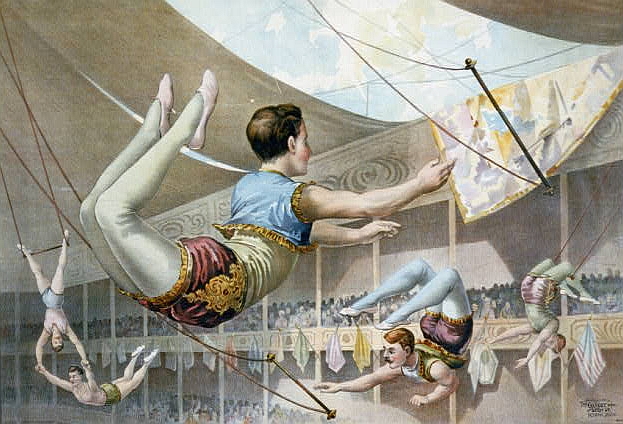
File:Trapeze artists 1890.jpg
See how the first dark takes the city in its arms1
And carries it into what yesterday we called the future.

O, the dying are such acrobats.
Here you must take a boat from one day to the next,

Or clutch the girders of the bridge, hand over hand.
But they are sailing like a pendulum2 between eternity and evening,

Diving, recovering, balancing3 the air.
Who can tell at this hour seabirds from starlings,

Wind from revolving doors or currents off the river.
Some are as children on swings pumping higher and higher.

Don't call them back, don't call them4 in for supper.
See, they leave scuff marks like jet trails on the sky.

1: This is personification because the writer describes the dark as a person by giving it arms to hold the city.

2: The writer uses a simile to compare how the two objects sing back and forth.

3: The writer uses rhythm by adding the –ing to the end of the words

4: The writer uses hyperbole because it is exaggerating the emotion on one person.


Setting: The setting of this place would be in a city during the night and somewhere near the ocean.


The speaker of this story would be the darkness and how it takes over the city when the sun has gone to the other side of the planet. The speakers talks about how everything is moving and about the people. The audience would be the town and how the dark hold it’s in its arm once everyone has gone to bed. The writer uses this type of language to get the reader to understand from his side of the story. The purpose of the story is to let peoples know how some cities can be really colorful when all the lights are out and when the sun is gone. The author’s tone of this poem is a tone that seems really nice and kind and just the way she talks about it. Her mood is a happy mood because of the way she compares things and the way she talks about it.

شرح اخر                                                                 
Trapeze
Deborah Digges


See how the first dark takes the city in its arms 
and carries it into what yesterday we called the future. 


O, the dying are such acrobats. 
Here you must take a boat from one day to the next, 


or clutch the girders of the bridge, hand over hand. 
But they are sailing like a pendulum between eternity and evening, 


diving, recovering, balancing the air. 
Who can tell at this hour seabirds from starlings, 


wind from revolving doors or currents off the river. 
Some are as children on swings pumping higher and higher. 


Don't call them back, don't call them in for supper. 
See, they leave scuff marks like jet trails on the sky.


This hit me like a sock in the jaw--it seems to get the mood of a writer who has an intense sense of that all manner of gravity, both natural and moral, has ceased to exist that the material world and the conduct of the population was now free to play, wander , roam, let themselves go into a an vertiginous , all embrace void. These very much resembles Yeats, and the ringing rhetorical and hard edged images resound like "Easter 1916". The difference between the two, of course, is that Yeats' poem was a prophecy, and his poem was apprehensive because everything old was being made new with new uses, new meanings, remolded from a new philosophy. Terrible in the unknown and beautiful in the sense that life processes cannot be stopped, only made into something new , different. Digges gives the feeling of the floor, the sidewalk, the street giving way from under you , that the conditions of conduct are suspended or revoked outright, and that the life goes to an inevitable, ecstatic end. 


Some are as children on swings pumping higher and higher. 


Don't call them back, don't call them in for supper. 
See, they leave scuff marks like jet trails on the sky. 


These last lines get the pitch exactly, the pull toward a personal apocalypse being so strong that the bounds of reason, protocol, faith are undone. It's a seduction to the darkest yearning, to enter a sphere where there is no contradiction, no agitation, no weighted arguments with the balance of one's universe. To become nothing. It's a plea, as well, for the families, the friends, the passers by to cease heroic efforts to prevent the inevitable and accept one's decision to be raptured.The nihilistic lure is overpowering here, and one is made to feel that there is nothing for this speaker to do but to surrender to natural forces, to embrace the inevitable end. 


What gets me in the poem is how it makes the Big Sleep, the Large Nod, the Humongous Nap an attractive state; life consists mostly of temporary problems requiring our wits and ingenuity with which to engineer remedies. It's a wearying task as the years go on, and Digges , it seems to me, writes from a point of view of someone approaching their nadir, the breaking point when what passes for ironic disengagement, the activity of minimizing one's labors in just getting through the day, becomes an encroaching obsession for a permanent solution . The narrator seems envious of the dead, as you say, but I think there's a real desire here to leave this sphere of being. The weightlessness and unboundedness of the dead suggests desire, a deferred longing . The narrator sounds like she is desirous of what the dead get to do in the universe as we understand it, which is nothing. The desire is to do nothing and to be nothing in turn.The foreknowledge that every living thing dies finally crowds the poem like a Bosch painting--one last intense set of indulgences of the human senses, and then ride the sensual tide to a darkness one cannot report back from. This is beautiful, unnerving, slightly scary.


Twitter Delicious Facebook Digg Stumbleupon Favorites More

 
www.hypersmash.com